

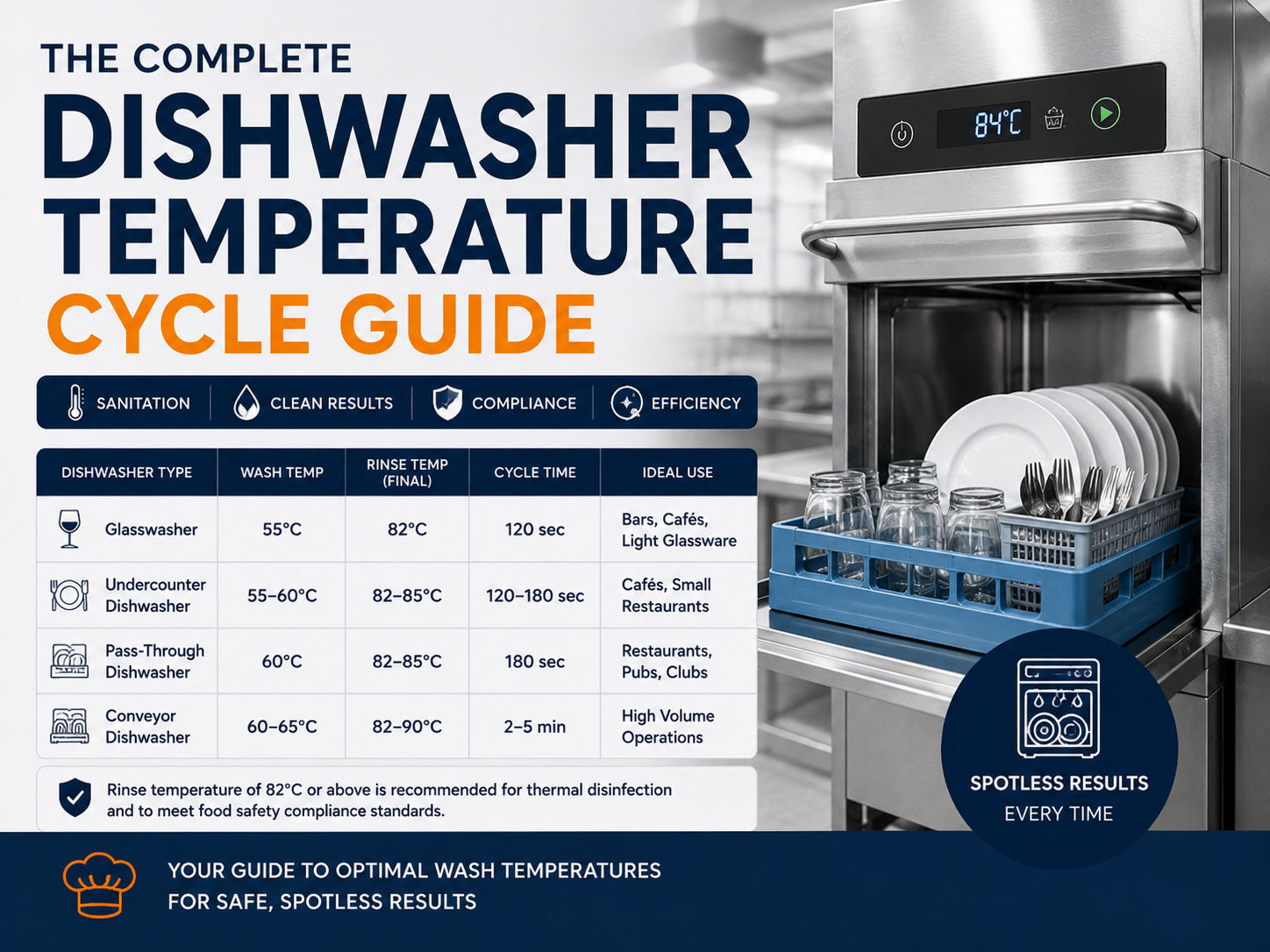
Commercial Dishwasher Temperature Guide: Wash, Rinse and Sanitising Temperatures
A commercial dishwasher that isn't operating at the correct temperature is either not sanitising effectively or leaving spotty, poorly-cleaned product on the pass. In a licensed food premises, inadequate dishwasher sanitisation is a food safety compliance issue — not just an operational inconvenience. This guide covers the correct wash and rinse temperatures for each commercial dishwasher type, what Australian standards require, and how to diagnose common temperature-related problems.
Why Dishwasher Temperature Matters
Temperature performs two distinct jobs in a commercial dishwasher: cleaning and sanitising. These are separate functions that happen at different stages of the cycle:
- Washing (60–65°C) — Hot water activates detergent chemistry, loosens fats and proteins, and removes food soil. Below this temperature, detergent efficacy drops significantly and grease does not emulsify properly.
- Rinsing / sanitising (82–85°C+) — The final hot rinse achieves thermal sanitisation by exposing surface bacteria to temperatures that kill them. This is the food safety-critical step. The Australian standard requires wash water to reach 82°C at the spray arms for thermal sanitising to be confirmed.
If the wash temperature is too low, you get dirty dishes. If the rinse temperature is too low, you get unsanitised dishes — which look clean but may carry pathogenic bacteria onto the next customer's plate.
Wash vs Rinse Temperature Explained
Every commercial dishwasher cycle has at minimum two temperature-critical phases:
- Pre-rinse / scrape cycle — Some machines include a pre-rinse at lower temperature (35–45°C) to remove gross food soil before the main wash. Not all machines have this stage.
- Wash cycle — The main cleaning phase. Hot water + detergent at 55–65°C. Duration varies from 60 seconds (underbench) to several minutes (conveyor).
- Final rinse — The sanitising phase. Fresh clean hot water at 82–85°C applied to the load. Contact time of 10–15 seconds minimum is typically required for effective thermal kill. The boiler (also called a rinse booster) heats water to this temperature independently of the wash tank.
The rinse booster is a separate heating element that raises rinse water above wash water temperature. It must be maintained and functioning correctly — a failed rinse booster means the machine is not sanitising, even if the wash temperature is correct.
Dishwasher Temperature Chart
| Dishwasher Type | Wash Temp | Rinse Temp | Sanitising Method | Notes |
|---|---|---|---|---|
| Underbench (door-type) | 55–65°C | 82–85°C | Thermal | Most common in cafés and small restaurants. Short cycle (90–120 sec). Rinse booster must maintain 82°C at spray arm. |
| Pass-through (hood-type) | 60–65°C | 82–85°C | Thermal | Higher throughput than underbench. Used in medium–large kitchens. Rinse temp at spray arm is the compliance measurement point. |
| Conveyor / flight-type | 60–65°C | 82–85°C | Thermal | High-volume operations (hospitals, hotels, caterers). Multiple wash/rinse zones. Monitor temperature at each zone. Belt speed affects contact time. |
| Glasswasher (thermal) | 50–55°C | 60–65°C | Thermal (lower) + chemical | Lower temperatures protect glassware from thermal shock. Typically relies on chemical sanitiser in rinse aid. Check chemical dosing regularly. |
| Glasswasher (chemical sanitise) | 45–55°C | 50–55°C | Chemical (chlorine/iodine) | Temperature alone does not sanitise at these levels. Correct chemical concentration (ppm) is critical. Check dispenser calibration weekly. |
| Low-temp underbench (chemical) | 50–55°C | 50–55°C | Chemical | Used where hot water supply is limited. Lower energy cost. Chemical sanitiser must be verified at correct concentration — typically 50–100ppm chlorine. |
Australian Compliance Standards
Commercial dishwashers in Australian food premises are subject to several compliance frameworks:
AS 4674 — Design, Construction and Fitout of Food Premises
AS 4674 governs the design and fitout requirements for commercial food premises, including warewashing equipment. It requires that dishwashing facilities be capable of effectively cleaning and sanitising all equipment and utensils that contact food.
FSANZ Standard 3.2.2 — Food Safety Practices and General Requirements
Under FSANZ Standard 3.2.2, food businesses must ensure that all equipment used in the preparation and service of food is kept clean and, where applicable, sanitised. For dishwashers, this means the sanitising step — whether thermal or chemical — must achieve effective reduction of food safety hazards.
- Rinse temperature at the spray arm (not the boiler — the water must be hot when it hits the load)
- Chemical sanitiser concentration (for low-temp or chemical sanitise machines)
- Cleanliness of wash tank water and filter condition
- Whether the machine is being used correctly (not overloaded, racks loaded properly)
Keep a temperature log for your dishwasher if you are operating under a formal HACCP-based food safety program. Record the rinse temperature at the start of each service and after any service period or malfunction.
For further guidance on servicing and maintenance schedules that affect temperature performance, see our article on whether your commercial dishwasher needs servicing.
Common Dishwasher Temperature Problems
| Problem | Likely Cause | Fix |
|---|---|---|
| Dishes coming out wet or spotted | Rinse temperature too low; insufficient rinse aid; water hardness | Check rinse booster is reaching 82–85°C; increase rinse aid dosing; consider water softener if in hard water area |
| Glasses coming out cloudy | Limescale build-up (hard water); etching from over-temperature; incorrect detergent dosing | Descale machine; check water temperature not exceeding glasswasher limits; review detergent concentration |
| Rinse temp not reaching 82°C | Failed rinse booster element; scale build-up on boiler element; insufficient incoming water pressure | Check boiler element and thermostat; descale if scale-affected; verify water pressure at machine inlet (typically 2–4 bar) |
| Wash temp dropping during service | Overloading; short cycle time; wash tank element failing; tank not refilling properly | Reduce load frequency; check wash tank element; ensure float valve is functioning; verify incoming hot water supply temp |
| Greasy film on dishes after washing | Wash temperature too low; detergent dosing too low; wash tank water dirty / needs changing | Check and adjust wash temperature; increase detergent dose; drain and refill wash tank; check filter is clean |
| Chemical sanitiser not working (low-temp machines) | Dispenser pump failure; chemical supply exhausted; chemical diluted incorrectly | Test chemical concentration with test strips; check and prime dispenser pump; refill chemical supply |
| Machine taking too long to heat up | Scale on heating elements; element partially failed; cold incoming water supply | Descale elements; check element resistance; ensure incoming water is at correct pre-heat temperature |
| Error code / temperature alarm | Thermostat fault; temperature sensor failure; element failure | Refer to machine manual for specific error codes; call qualified service technician if component failure indicated |
Choosing a Commercial Dishwasher
The right dishwasher depends on your throughput, space, water supply and menu requirements. Key selection criteria:
- Throughput capacity — Measured in racks per hour (underbench/pass-through) or plates per hour (conveyor). Size for peak service, not average.
- Thermal vs chemical sanitising — Thermal is the default for most Australian commercial kitchens. Chemical sanitising suits glasswashing or locations with limited hot water supply.
- Water softener / scale protection — Hard water is common in many Australian regions. Hard water rapidly scales rinse boiler elements and reduces machine life. Consider a built-in or inline water softener.
- Energy and water consumption — Higher-end machines use heat recovery systems to reduce energy costs.
- Rack and basket compatibility — Check that the rack size matches your existing plate, glass and cutlery basket sizes. Standard European racks are 500 × 500mm.
- Drain pump or gravity drain — Drain pump models can be installed where the drain point is above the machine. Gravity drain requires the drain to be at or below machine level.
Shop Commercial Dishwashers at Hospitality Connect
Underbench, pass-through, conveyor and glasswashers for Australian commercial kitchens. All units meet Australian food safety temperature requirements for thermal sanitisation.
Shop Commercial Dishwashers →

