

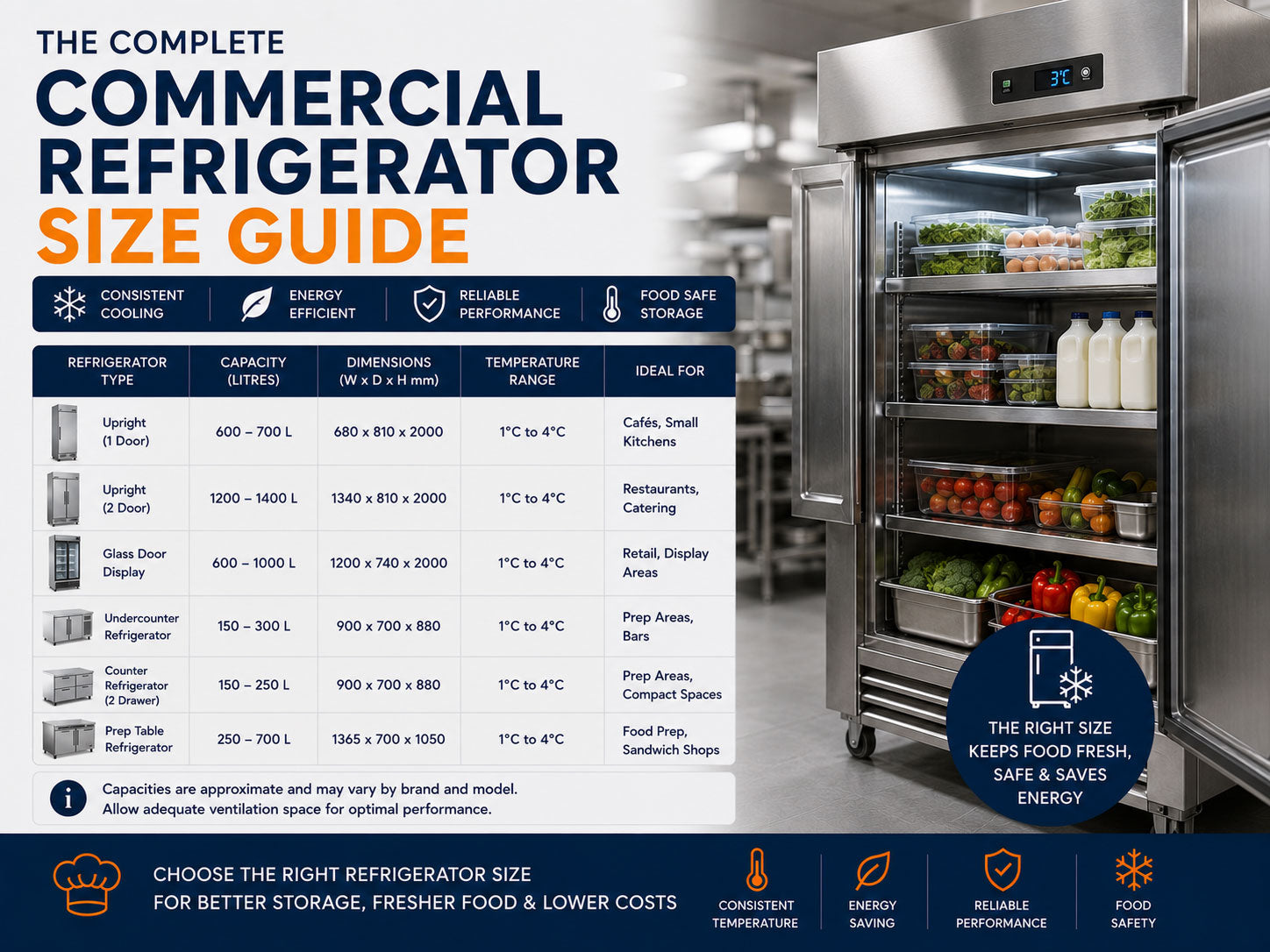
Commercial Refrigerator Size Guide: Choosing the Right Capacity for Your Kitchen
Choosing the wrong commercial refrigerator capacity is one of the most expensive mistakes you can make in a kitchen fitout. Too small and you're cramming product, compromising food safety, and making multiple runs to cold storage mid-service. Too large and you're paying to refrigerate dead air and occupying valuable kitchen floor space.
This guide explains how to read capacity specifications, match fridge types to use cases, and calculate what you actually need.
Commercial Fridge Capacity Explained
Commercial refrigerator capacity is typically expressed in litres (L) in Australia. You'll occasionally see cubic feet (cu ft) on imported product specs — 1 cu ft ≈ 28.3 litres.
Gross capacity vs net capacity:
- Gross capacity: The total internal volume of the cabinet. This is the number most commonly quoted in marketing specs.
- Net (usable) capacity: The actual usable space after accounting for shelving, evaporator coils, fans and internal fittings. Net capacity is typically 65–80% of gross capacity.
For food safety and temperature compliance, see our guide to commercial fridge temperature requirements.
Refrigerator Types and Their Use Cases
| Type | Capacity Range | Best For | Footprint |
|---|---|---|---|
| Underbench Refrigerator | 60–250L | Below prep bench or bar; supplementary cold storage; ingredient access at the station | 600–900mm W × 600–700mm D × 850mm H |
| Upright 1-Door | 300–600L | Small kitchens, cafés, bakeries; general ingredient storage | 600–700mm W × 600–700mm D × 1,850–2,000mm H |
| Upright 2-Door | 900–1,400L | Restaurants, hotels, institutional kitchens; primary cold storage | 1,200–1,400mm W × 700mm D × 1,900–2,100mm H |
| Upright Glass Door | 300–1,200L | Front-of-house display, beverage fridges, retail display | As per solid door equivalents |
| Prep / Saladette Fridge | 200–600L | Pizza prep, salad bars, sushi prep — cold storage + accessible prep surface in one unit | 1,000–2,000mm W × 700mm D × 850–900mm H (surface) |
| Display / Deli Fridge | 200–800L | Retail display, grab-and-go, café counter display | 900–2,000mm W × 600–700mm D × 1,200–1,500mm H |
Capacity Comparison Table
| Net Capacity (L) | Estimated Cover Capacity | Typical Venue Type | Approx. Dimensions (W × D × H) |
|---|---|---|---|
| 80–150L | Up to 20–30 covers | Small café, food truck, kiosk | 600 × 600 × 850mm (underbench) |
| 200–350L | 30–60 covers | Café, small restaurant, bakery | 600–700 × 600 × 1,900mm (upright 1-door) |
| 400–600L | 60–100 covers | Mid-sized restaurant, pub kitchen | 700 × 700 × 2,000mm (upright 1-door) |
| 700–1,000L | 100–180 covers | Full-service restaurant, hotel kitchen, club | 1,200–1,400 × 700 × 2,000mm (upright 2-door) |
| 1,000–1,400L | 180–300+ covers | High-volume restaurant, events kitchen, institutional | 1,400 × 700 × 2,100mm (upright 2-door) |
Space Planning Considerations
Door Swing Clearance
This is the most frequently overlooked dimension in kitchen planning. An upright fridge door opens to 90–115° depending on model. You need:
- Full door width as clearance in front of the unit for access
- Minimum 700–800mm from the fridge face to any opposite wall or equipment to comfortably load and unload shelves
- Check whether the door is reversible — most commercial fridges allow hinge reversal; specify at time of order for fitted kitchens
Ventilation Clearance
Air-cooled condensers need airflow to operate efficiently and maintain food safety temperatures:
- Sides: Minimum 100–150mm clearance from walls or adjacent equipment
- Rear: 100–150mm from the wall (rear-condensing models); some front-breathing models can be installed flush — check specifications
- Top: Where condenser is top-mounted, allow 200–300mm for heat dissipation
Floor Levelling
Commercial refrigerators must be level for the door seal to function correctly and for the condensate drain to flow properly. Use the adjustable feet to level — most units provide 20–40mm of adjustment.
Common Sizing Mistakes
- Sizing for today, not 18 months from now. If you're a new venue growing into your covers, size up by one tier. Retrofitting a larger fridge into a fitted kitchen mid-operation is expensive and disruptive.
- Comparing gross capacity across brands. A 600L fridge from Brand A may have significantly more usable shelf space than a 600L fridge from Brand B. Compare net capacity and shelf count.
- Ignoring door swing in the floor plan. Consistently one of the most common kitchen design errors — the fridge fits but the door can't open fully without hitting the bench opposite.
- Installing against cooking equipment without separation. Even a metre of separation between a fryer and a refrigerator makes a material difference to compressor load and service life.
- Forgetting condenser clearance. Blocking rear or side vents — even partially — will cause the unit to run at elevated temperatures, compromising food safety compliance and triggering premature compressor failure.
What to Look for When Buying
- Temperature range: Confirm the unit maintains 0–5°C under full load in Australian ambient conditions (some cheaper units struggle above 30°C ambient). Look for units rated to 43°C ambient (Climatic Class 4/5).
- Energy efficiency: Refrigerators run 24/7. Check the annual energy consumption figure (kWh/year) in the spec sheet — this directly impacts running costs.
- Shelf load rating: Commercial shelves should be rated to at least 40–60kg per shelf. Verify if you're storing heavy containers.
- Door seal and gasket quality: Easy-to-replace magnetic door gaskets significantly reduce maintenance costs over time.
- Digital thermostat and alarm: Required for HACCP-compliant operations. Confirms the unit can maintain documented temperature logs.
- Local service support: Confirm service agents are available in your state for the brand you choose before committing.
Browse Commercial Refrigeration
Explore Hospitality Connect's full range of commercial refrigerators — underbench, upright, prep fridges and display units from trusted brands.
Shop Commercial Refrigeration →

