

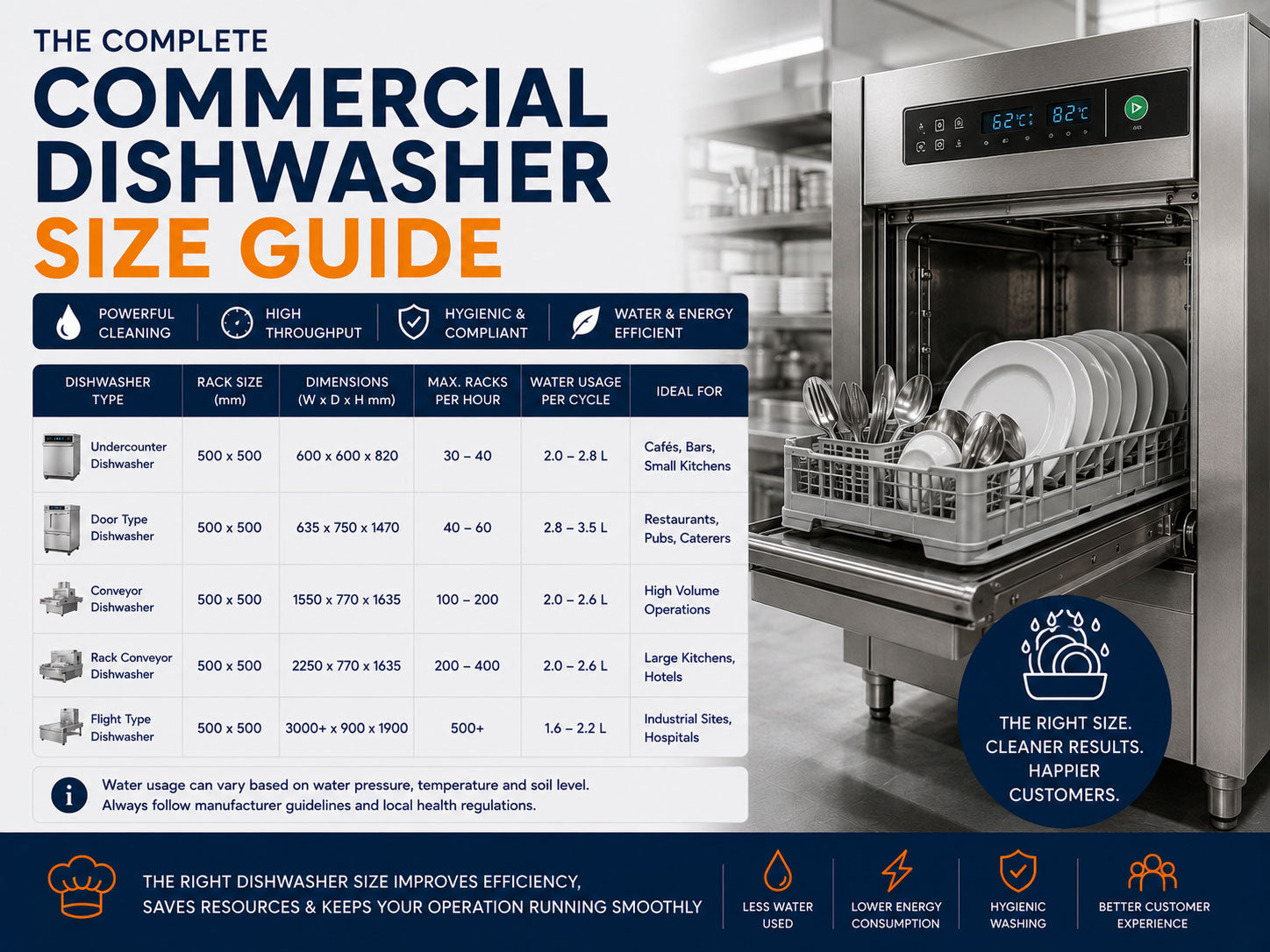
Commercial Dishwasher Size Guide: Choosing the Right Machine for Your Venue
The right commercial dishwasher keeps your service running. The wrong one creates bottlenecks, breakages, unhappy staff and a mountain of handwashing in the middle of a busy service. Before you spec a machine, you need to know two things: how much ware you need to turn over per hour, and what space you have to put the machine in.
Dishwasher Types and Their Capacity
Commercial dishwashers fall into three main categories, each suited to different throughput volumes and kitchen configurations:
Underbench / Glasswasher
These are compact machines that fit under a standard 900mm bench. They handle one rack at a time with a door that opens on the front. Cycle times are typically 90–120 seconds. Best for low-to-medium volume operations where floor space is constrained. Note that glasswashers use lower temperatures and gentler cycles than full dishwashers — don't use a glasswasher for food-contact plates if it's not rated for sanitising temperatures.
Pass-Through / Hood-Type
The industry workhorse. A rack slides into the machine, the hood comes down, the cycle runs (typically 60–120 seconds), and the rack comes out the other side onto a clean staging table. Staff load one end, unload the other — efficient, fast and ergonomic when set up correctly. Requires inlet and outlet benching space either side.
For a deep-dive on pass-through dishwashers, see our guide: The Ultimate Guide to Commercial Pass-Through Dishwashers.
Conveyor / Rack Conveyor
For high-volume operations — large hotels, universities, event catering, hospitals. Racks move continuously through a tunnel-style machine. Output can exceed 250+ racks per hour. These are major infrastructure investments and require significant space and utility provisions (3-phase power, hot water, drain capacity).
Capacity Comparison Table
| Machine Type | Racks / Hour | Covers / Hour Equivalent | Ideal Venue Size | Footprint (approx.) | Price Tier (AUD) |
|---|---|---|---|---|---|
| Glasswasher (underbench) | 20–40 | Up to 40 covers | Small bar, café, kiosk | 430–600mm W × 500mm D × 850mm H | $1,500–$3,500 |
| Underbench Dishwasher | 20–30 | Up to 60 covers | Small café, takeaway, food truck | 600mm W × 600mm D × 850mm H | $2,500–$5,000 |
| Pass-Through (mid-range) | 40–60 | 60–120 covers | Café, bistro, pub kitchen | 600–660mm W × 700mm D × 1,450mm H (hood up) | $5,000–$12,000 |
| Pass-Through (high-capacity) | 60–100 | 120–200 covers | Full-service restaurant, club, hotel | 660–720mm W × 750mm D × 1,500mm H (hood up) | $10,000–$20,000 |
| Conveyor / Rack Conveyor | 150–350+ | 300–700+ covers | Hotels, catering, institutional | 3,000–6,000mm L × 800mm W (varies) | $30,000–$80,000+ |
How to Calculate Your Throughput Requirements
Here's the working formula:
- Determine covers per service: Use your peak service period (e.g. 120 covers in a 2-hour dinner service)
- Estimate items per cover: Count all plates, bowls, glasses, cutlery pieces per setting. A typical restaurant cover = 2–3 plates + 2–3 glasses + full cutlery set ≈ 8–12 pieces per cover
- Calculate pieces per hour: 120 covers × 10 pieces = 1,200 pieces over 2 hours = 600 pieces/hour
- Convert to racks per hour: A standard commercial rack holds approximately 25 plates, or 36 glasses. Mixed loads average ~20–25 pieces. 600 pieces ÷ 20 pieces per rack = 30 racks/hour
- Add a buffer: Add 20–30% for re-washes, peaks in the service, and handover time between racks. 30 × 1.25 = 38 racks/hour minimum machine capacity
Water and Chemical Usage Comparison
| Machine Type | Water per Rack (L) | Energy per Rack (kWh) | Chemical Cost Indicator | Notes |
|---|---|---|---|---|
| Underbench glasswasher | 2.5–4L | 0.05–0.10 | Low | Low water volume suits glass-only operation |
| Underbench dishwasher | 3–5L | 0.10–0.18 | Low–Medium | Uses detergent + rinse aid; check booster heater sizing |
| Pass-through (standard) | 2.5–4L | 0.15–0.25 | Medium | Most efficient per-rack water use at this tier |
| Pass-through (heat recovery) | 2.5–3.5L | 0.10–0.18 | Medium | Heat recovery condenser reclaims energy from exhaust steam — reduces energy costs 20–30% |
| Conveyor | 0.8–1.5L | 0.05–0.12 | High (volume) | Best per-rack water/energy efficiency at scale; high absolute consumption due to throughput |
For venues on water restrictions or high utility tariffs, a pass-through with heat recovery condenser can pay for the premium in utility savings within 12–18 months at moderate throughput.
For more on maintaining your machine, see: Should I Get My Commercial Dishwasher Serviced? Why It's Worth It.
Common Sizing Mistakes
- Sizing to average throughput, not peak: Your machine has to handle the dinner rush, not Tuesday lunch. Calculate for peak service and add your buffer on top of that.
- Ignoring staging bench space: A pass-through dishwasher without adequate soiled inlet table and clean outlet table creates immediate bottlenecks. Allow minimum 900mm each side; 1,200mm preferred. Without it, clean ware and soiled ware clash and staff can't keep up.
- Underspecifying the hot water supply: Commercial dishwashers draw large volumes of hot water rapidly. If your hot water system can't maintain supply temperature, wash performance and sanitisation effectiveness both drop. Confirm the incoming water temperature and flow rate against machine specs.
- Buying a glasswasher for a full kitchen: Glasswashers use gentler cycles and lower temperatures — they're not a substitute for a commercial dishwasher for plates and kitchen ware.
- Not checking drain height compatibility: Some pass-through models drain at a specific height that may not match your existing floor waste configuration. Confirm drain specs before purchase.
What to Look for When Buying
- Cycle time: Shorter cycles improve throughput but require adequate hot water recovery. Check manufacturer-stated racks/hour under continuous operation.
- Heat recovery condenser: Worth the premium for any machine doing 50+ racks/day. Reduces steam in the kitchen and energy costs.
- Self-cleaning programs: Machines with automatic descaling and self-clean programs reduce maintenance labour and extend service life.
- Chemical dosing pump integration: Built-in peristaltic pumps for detergent and rinse aid ensure consistent dosing and reduce waste.
- Rack compatibility: Check rack dimensions are compatible with your existing ware if you're replacing an existing machine. Standard racks are 500×500mm — most machines are compatible, but confirm.
- Service agent availability: Dishwashers are mission-critical equipment. Confirm your chosen brand has service agents in your area with parts in stock.
Browse Commercial Dishwashers
Shop Hospitality Connect's range of commercial dishwashers — underbench, pass-through and glasswasher models suited to every venue size.
Shop Commercial Dishwashers →

