

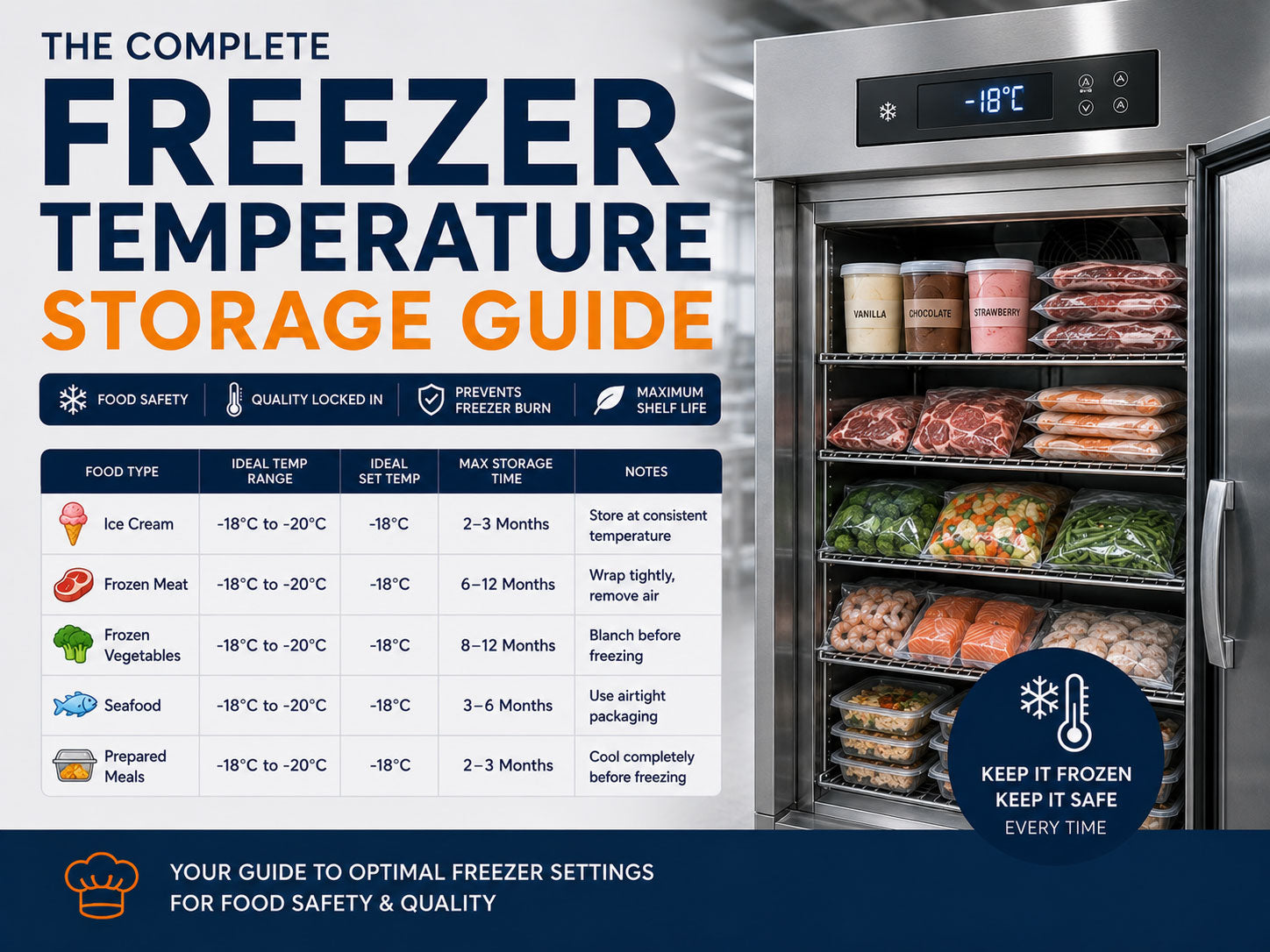
Commercial Freezer Temperature Guide
Freezer temperature is one of the few things in a commercial kitchen that cannot be improvised. Under FSANZ (Food Standards Australia New Zealand) Standard 3.2.2, potentially hazardous frozen food must be kept frozen — effectively at or below −18°C. Getting this wrong means food safety violations, spoiled stock, and wasted money. This guide covers the correct temperatures for every frozen food category, how to prevent common freezer problems, and what to look for when choosing equipment.
Ideal Freezer Temperature Range
The Australian legal standard for frozen food storage is −18°C or colder. This is not a guideline — it is the minimum required by food safety law. In practice, most commercial operators run their freezers at −18°C to −22°C to provide a buffer against door openings and ambient heat load.
Different products have different optimal storage temperatures:
- Standard frozen food storage: −18°C to −22°C
- Ice cream and gelato: −25°C to −30°C
- Quick-freeze / blast freezing: −30°C to −40°C
- Long-term frozen meat storage: −25°C or below to maximise shelf life
Frozen Food Storage Temperature Chart
| Food Category | Ideal Storage Temp | Max Safe Temp (FSANZ) | Typical Shelf Life | Quality Notes |
|---|---|---|---|---|
| Beef, lamb, pork (whole cuts) | −18°C to −25°C | −18°C | 6–12 months | Wrap tightly; freezer burn accelerates above −18°C |
| Chicken (whole/portions) | −18°C to −22°C | −18°C | 6–9 months | High fat skin prone to rancidity; use within 6 months for best quality |
| Minced meat / burger patties | −18°C to −22°C | −18°C | 3–4 months | Greater surface area = faster quality loss; label and rotate rigorously |
| Fish & seafood | −18°C to −25°C | −18°C | 3–6 months | Lean fish lasts longer than oily varieties; vacuum pack extends life |
| Vegetables (blanched) | −18°C to −22°C | −18°C | 8–12 months | Blanch before freezing to deactivate enzymes |
| Bread & baked goods | −18°C to −22°C | −18°C | 1–3 months | Double-wrap for longer storage |
| Prepared meals / cooked food | −18°C to −22°C | −18°C | 1–3 months | Must be blast-chilled before freezing; do not freeze warm food |
| Ice cream / gelato | −25°C to −30°C | −18°C (hard frozen) | 3–6 months (opened) | Texture degrades with temperature cycling |
| Dairy (butter, cheese) | −18°C to −22°C | −18°C | 6–12 months | Cheese may crumble after freezing; best used in cooked applications |
| Pastry (raw, uncooked) | −18°C to −22°C | −18°C | 3–6 months | Keep flat; avoid stacking before fully frozen |
Preventing Freezer Burn
Freezer burn is dehydration and oxidation at the food surface. It doesn't make food unsafe but ruins texture and flavour. The main causes are air exposure and temperature fluctuation.
- Use airtight containers or vacuum-seal bags wherever possible
- Minimise time between portioning and freezing
- Never leave the freezer door open longer than necessary during service
- Don't overload the freezer — air needs to circulate around products
- Avoid placing hot or warm product directly into the freezer; always blast chill first
- Check door seals regularly — a leaking seal causes moisture ingress and frost build-up
Food Safety Best Practices
Blast chill before freezing. FSANZ requires that cooked food be cooled from 60°C to 21°C within 2 hours, and from 21°C to 5°C within a further 4 hours. Never place hot food directly into a freezer.
Portion before freezing. Freeze in service-ready portions. Repeatedly thawing and re-freezing is both a food safety risk and a quality issue. Label each portion with the product name and freeze date.
FIFO stock rotation. First In, First Out is the standard — new stock goes behind older stock. Date labelling must be visible and consistent.
Thawing safely. Frozen food should be thawed in a refrigerator (below 5°C), never on a bench at room temperature. Once thawed, cook within 24 hours and do not refreeze.
Log temperatures daily. Manual or digital logs of minimum and maximum freezer temperatures provide a paper trail for food safety compliance audits.
Common Freezer Problems
| Problem | Likely Cause | Fix |
|---|---|---|
| Temperature not reaching −18°C | Overloading, dirty condenser coils, door seal failure, refrigerant issue | Reduce stock load; clean condenser; check/replace door seals; call refrigeration technician |
| Excessive frost build-up | Door seal failure, door left open, faulty defrost system | Inspect and replace door gaskets; check defrost timer/heater; manual defrost if needed |
| Compressor running constantly | Ambient temperature too high, refrigerant low, condenser blocked | Ensure adequate ventilation around unit; clean condenser coils; check refrigerant charge |
| Ice crystals forming inside packaging | Temperature fluctuation, door cycling, packaging not airtight | Improve door discipline; check seal integrity; switch to vacuum packaging |
| Freezer not cold enough after loading | Warm product added, unit undersized for load | Blast chill product before freezing; consider a larger or second unit |
| Water pooling inside cabinet | Blocked drain line, defrost draining incorrectly | Clear drain line; check drain pan and heater |
| Noisy compressor or fans | Loose components, fan hitting frost build-up, worn bearings | Defrost unit; tighten or replace components; call service technician |
Choosing the Right Commercial Freezer
Reach-in upright freezers are the most common commercial choice. Good capacity with convenient access, suits both storage and service, fits into tight kitchen layouts.
Chest freezers are more energy efficient and hold temperature better, but accessing stock from the bottom is cumbersome. Better suited to bulk storage accessed infrequently.
Under-counter / prep freezers suit front-of-house and bar environments where space is limited. Not suitable as a primary storage freezer for a busy kitchen.
Blast freezers / blast chillers with freeze function are purpose-built for rapid temperature reduction. Essential for any kitchen preparing and freezing significant volumes of cooked product.
Ice cream display freezers operate at −25°C to −30°C and are designed for consistent temperature and frequent access.
Browse Commercial Freezers at Hospitality Connect
Reach-in freezers, chest freezers, blast chillers and ice cream display units — all suited to Australian commercial kitchens.
Shop Commercial Freezers

