

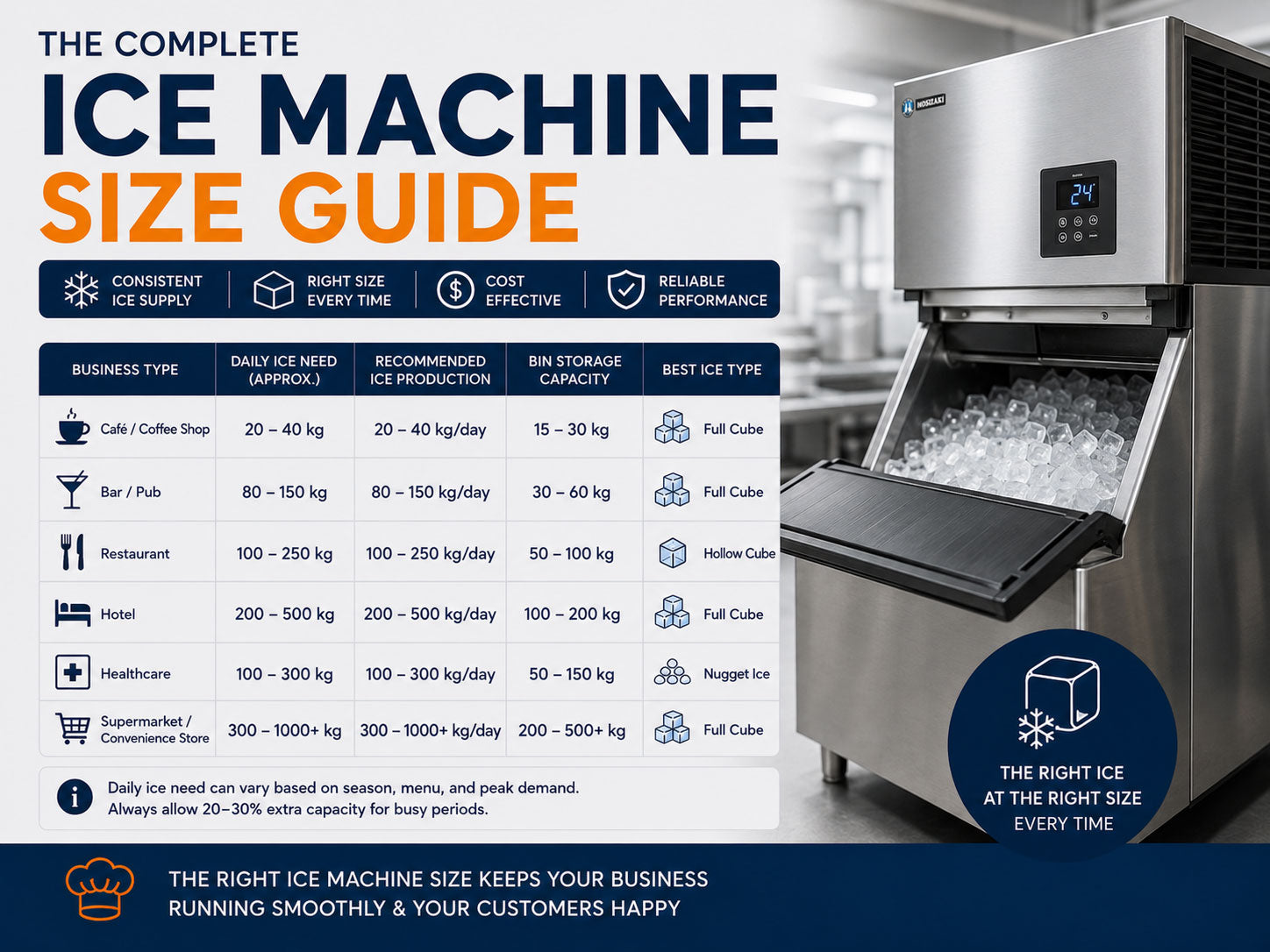
How Much Ice Does Your Business Need?
Undersizing your ice machine is one of the most common — and most disruptive — equipment mistakes in hospitality. Run out of ice during a Friday dinner service and you'll know about it. Oversize it and you're paying for production capacity that sits idle and wastes energy.
The right size comes down to one calculation: how many kilograms of ice your venue consumes per day at peak demand. Here's how to work it out.
Calculating Your Daily Ice Requirement
The standard industry formula is:
Daily ice requirement (kg) = Peak covers per day × Ice per cover (kg)
Use your busiest day — typically a Friday or Saturday — not your average day. You need to size for peak demand, not average demand. Then add a 20–25% buffer for hot weather, unexpected demand spikes, or ice used in food prep and storage.
For example: a 120-seat restaurant doing 200 covers on a busy Friday, at 0.6kg ice per cover = 120kg/day. Add 25% buffer = 150kg machine output required.
Daily Ice Requirements by Venue Type
| Venue Type | Primary Ice Use | Ice per Cover/Unit (kg) | Example: 100 covers/rooms | Recommended Machine Output |
|---|---|---|---|---|
| Bar / Cocktail Bar | Drinks service, ice wells, cocktails | 1.0–1.5 kg per cover | 100–150 kg/day | 150–200 kg/24hr |
| Casual Dining Restaurant | Drinks, seafood display, bar service | 0.5–0.7 kg per cover | 50–70 kg/day | 80–100 kg/24hr |
| Fine Dining Restaurant | Drinks, tableside, kitchen prep | 0.6–0.8 kg per cover | 60–80 kg/day | 100–120 kg/24hr |
| Café (with cold drinks) | Iced coffee, smoothies, cold service | 0.3–0.5 kg per cover | 30–50 kg/day | 50–80 kg/24hr |
| Hotel (room service) | In-room ice buckets, bar service | ~1.5 kg per room/day | 150 kg/day (100 rooms) | 200–250 kg/24hr |
| Fast Food / QSR | Fountain drinks, chilled display | 0.2–0.4 kg per cover | 20–40 kg/day | 50–60 kg/24hr |
| Seafood / Fish Retailer | Display beds, packing, transport | Varies — display-dependent | 50–150+ kg/day | 100–200 kg/24hr |
Bin Capacity vs Production Rate Explained
These are two separate specifications that are frequently confused — and the confusion costs money.
- Production rate (kg/24hr): How much ice the machine can make in a 24-hour period under standard conditions. This is the number to size against your daily requirement.
- Bin capacity (kg): How much ice the storage bin can hold at any one time. When the bin is full, the machine stops producing.
If you have high consumption during service but low overnight demand, a higher bin capacity relative to production rate means the machine can work overnight to fill the bin, giving you a reserve buffer for peak service.
A common setup for a busy bar: a 150kg/24hr machine with a 100kg bin. The machine runs overnight and during quieter periods, the bin stays full, and service draws down without the machine needing to keep pace in real time.
Ice Type Comparison
| Ice Type | Best Application | Melt Rate | Storage Efficiency | Notes |
|---|---|---|---|---|
| Full Cube | Spirits, rocks glasses, bagged ice retail | Slow | High | Dense, clean presentation, premium bar use |
| Half Cube / Crescent | Soft drinks, blended drinks, general service | Medium | High | Most common type; good all-rounder |
| Nugget / Chewblet | Healthcare, blended drinks, salad bars | Fast | Medium | Soft, chewable, absorbs flavour — popular in casual dining |
| Flake | Seafood display, food preservation, medical | Very fast | Low | Moulds around product; excellent for display beds |
| Crushed | Cocktails, blended drinks, oyster bars | Fast | Low | Often produced via separate crusher attachment rather than dedicated machine |
Common Sizing Mistakes
- Sizing for average demand, not peak demand. Your machine needs to serve your busiest day, not a Tuesday lunch.
- Ignoring ambient temperature adjustments. A machine rated at 100kg/24hr is measured at 21°C ambient and 10°C water. In a Queensland kitchen in summer, output can drop to 75–80kg. Check the temperature-adjusted specs in the manufacturer's data sheet.
- Confusing bin capacity with production rate. A “100kg machine” from one brand might mean 100kg/24hr production with a 50kg bin. Another might mean a 100kg bin with a 60kg/24hr machine. Always read both specs.
- Not accounting for ice used in food prep. If your kitchen uses ice for cold bains marie, poaching, or rapid chilling, add this to your service calculation.
- Poor placement affecting output. Machines installed in hot, poorly ventilated areas or near cooking equipment produce significantly less ice. Allow 150mm clearance on sides and top for air-cooled models.
What to Look for When Buying a Commercial Ice Machine
- Production rate (kg/24hr): The core spec — size this to your peak daily requirement plus 20–25% buffer.
- Bin capacity: Should be sized to handle at least one full service period's consumption without needing real-time replenishment.
- Air-cooled vs water-cooled: Air-cooled is standard for most venues; water-cooled suits enclosed spaces but uses more water. Remote condenser models suit hot kitchens.
- Ice type: Match to your primary use case — don't buy a flake machine for a cocktail bar.
- Energy star rating: Ice machines run continuously — energy efficiency matters. Look for ENERGY STAR or equivalent rated models.
- Ease of cleaning: Sanitisation frequency requirements, accessibility of water lines and evaporator plates. Scale build-up is the primary cause of reduced output and machine failure.
- Service and parts availability: Ensure local service agents exist in your state for the brand you choose.
Browse Commercial Ice Machines
Shop Hospitality Connect's range of commercial ice machines — cube, flake and nugget models from leading brands, sized for Australian conditions.
Shop Ice Machines →

