

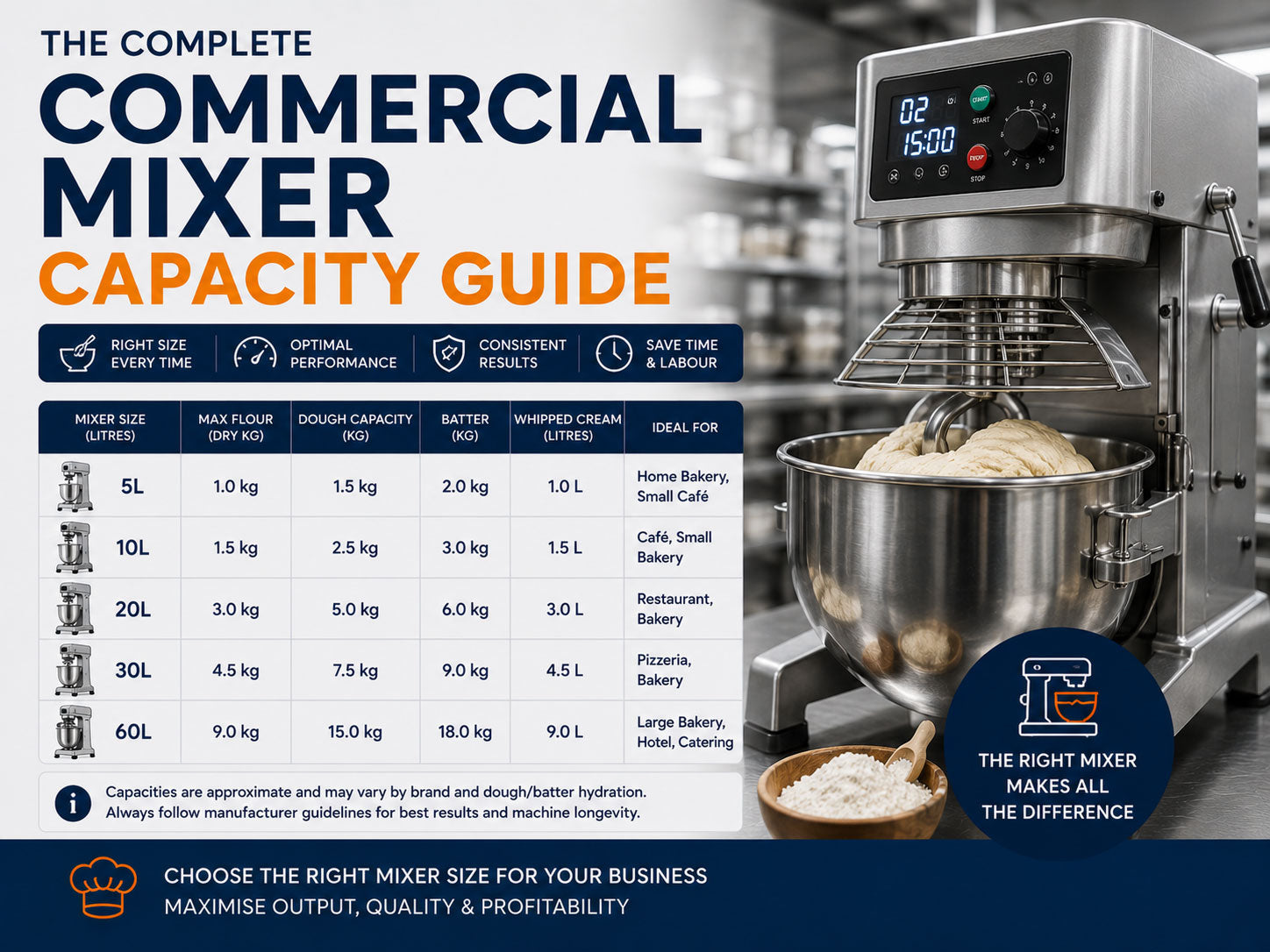
Commercial Mixer Size Guide: What Capacity Do You Actually Need?
Buying a mixer that's too small creates a bottleneck. Buying one that's too large wastes money, bench space, and energy. This guide gives you the specific numbers — bowl capacity, dough output, and ideal venue type — so you can match the right commercial mixer to your actual production requirements.
Commercial Mixer Capacity Explained
Commercial mixer capacity is quoted in litres (L) in Australia. Some manufacturers — particularly US brands — list bowl size in US quarts. The conversion is approximately 1 US quart = 0.946 litres; a 20-quart mixer is effectively a 19-litre unit.
Bowl capacity vs usable capacity. A mixer's rated bowl size is not the usable mixing volume. You should never fill a mixing bowl more than two-thirds full for batters and wet mixes, or more than half full for heavy dough — the machine needs headroom to work without splashing or motor strain.
Dough weight vs batter capacity. Dough is dense and puts more load on the motor than light batters. A 20L planetary mixer can typically handle 8–10kg of bread dough per batch but can handle significantly more litres of cake batter or cream. Always check the manufacturer's dough capacity specification, not just the bowl size — they are different figures.
Mixer Size Comparison Chart
| Bowl Capacity | Typical Dough Output / Batch | Batter Output / Batch | Ideal Venue Type | Examples / Common Use |
|---|---|---|---|---|
| 5–7 L | 2–3 kg | 3–4 L | Small café, patisserie, home-commercial | Cakes, small batches of biscuits, whipped cream, light pastry work; not suited to bread production |
| 10 L | 4–5 kg | 6–7 L | Café, small restaurant, small patisserie | Bread for in-house use (6–8 loaves/batch); consistent cake and pastry production; good entry-level commercial |
| 15 L | 6–8 kg | 9–10 L | Busy café, medium restaurant, small bakery | 10–14 loaves/batch; pizza dough for mid-volume pizzerias; brioche and enriched doughs |
| 20 L | 8–10 kg | 12–14 L | Bakery, busy restaurant, medium venue | 14–18 loaves/batch; the most common commercial bakery and restaurant mixer size; versatile anchor machine |
| 30 L | 12–15 kg | 18–22 L | Medium-large bakery, high-volume restaurant | 20–28 loaves/batch; bulk pastry; suited to venues producing across multiple product lines simultaneously |
| 40 L | 18–20 kg | 25–28 L | Large bakery, institutional catering | 30–38 loaves/batch; suits venues running 3–4 baking shifts; larger footprint — check bench/floor space |
| 60 L | 25–30 kg | 38–42 L | High-volume bakery, wholesale production | 50+ loaves/batch; typically floor-standing; 3-phase power required; serious production unit |
| 80–120 L | 40–60 kg | 55–80 L | Wholesale bakery, large institutional catering | Production-scale mixer; floor-standing only; requires 3-phase power; purpose-built installation required |
Bakery vs Café vs Restaurant Requirements
Bakery (artisan or production). Volume and dough weight are the primary drivers. A bakery producing 50+ loaves per day needs to run multiple batches efficiently — a 60L or larger mixer is the practical minimum for that output level. Artisan bakeries running shorter but more varied production often prefer two smaller mixers (e.g., two 20L units) rather than one large machine, for flexibility and redundancy.
Café. A busy café producing house-made cakes, muffins, slices, and occasional bread typically needs a 7–15L mixer. The mixing is varied — light batters, cream, icings — not heavy sustained dough work. A 10L model is the sweet spot for most busy cafés. If the café bakes its own bread in any volume, step up to 15–20L.
Restaurant. Restaurants using a mixer for pastry, pasta, and occasional bread typically need a 10–20L unit. The requirement is versatility across lighter applications. Restaurants with a serious pastry program or house-baked bread program should size up to 20–30L.
Pizzeria. Pizza dough is a medium-density dough. A pizzeria producing 40–60 pizzas per service should run a 20L minimum. High-volume operations (100+ pizzas/service) should consider a 30L planetary or a dedicated spiral mixer at similar capacity. Spiral mixers are designed specifically for dough and handle high-hydration doughs more effectively than planetary mixers.
Planetary vs Spiral vs Other Mixer Types
| Mixer Type | Best For | Capacity Range | Pros | Cons |
|---|---|---|---|---|
| Planetary mixer | General baking, cakes, pastry, light dough, cream, icings, pasta | 5–120 L | Versatile — three attachments (hook, whisk, paddle) cover most mixing tasks; widely available; easy to clean | Not ideal for large volumes of stiff dough; heat builds up in dough with prolonged use; motor stress at maximum capacity |
| Spiral mixer | Bread dough, pizza dough, high-volume dough production | 10–300 L | Designed specifically for dough; cooler dough temperatures; handles high-hydration doughs well; less motor stress at high loads | Single purpose — only mixes dough; no whisk or paddle function; larger footprint |
| Horizontal mixer | Very stiff doughs — bagels, pretzels, crackers | 30–500 L | Handles extremely stiff, low-hydration doughs that would stall other mixer types | Specialised; high cost; only suited to specific dough types; rarely needed outside specialist bakeries |
| Stick / immersion blender with bowl | Sauces, soups, small batches | 1–20 L | Low cost; highly versatile for liquid/semi-liquid tasks | Not a stand mixer; not suited to dough or structured mixing tasks |
| Bench-top hand mixer (commercial) | Small batches, front-of-house, occasional use | 1–5 L | Cheap; portable; easy to clean; low bench space | Not designed for sustained commercial production; motor burn-out risk if overused |
Attachment Context: Hook, Whisk, and Paddle
Planetary mixers come with three standard attachments. Understanding which to use matters — wrong attachment on a heavy dough will damage the machine and produce inferior results.
- Dough hook: The correct attachment for all bread, pizza, pasta, and heavy dough work. The hook mimics hand-kneading by folding and stretching dough. Start on low speed, increase to medium once the dough forms. Never run a dough hook at high speed under load.
- Flat paddle (beater): Used for cake batters, cookie dough, mashed potato, meatloaf mix, and anything that needs to be combined and aerated without developing gluten. The workhorse for pastry and café baking.
- Wire whisk: For incorporating air — whipping cream, meringue, mousses, sabayon, and light sponge batters. Only used on lighter preparations; never for dough or stiff mixtures.
Common Sizing Mistakes
Buying on price, not capacity. A 7L mixer at a good price is poor value if your café needs a 15L. You'll run it at full capacity every time, overheat the motor, and replace it within a year.
Not accounting for growth. If you're planning to add a bread program or expand your baking menu in the next 12 months, size up now. Mixer upgrades are disruptive and expensive mid-operation.
Forgetting about batch frequency. A 20L mixer may technically handle your daily dough volume if you run five batches a day — but five batches takes time and labour. A 30L unit running three batches a day is often more efficient. Calculate total batches per day, not just total kg.
Using the dough hook for cake batter. The hook doesn't incorporate enough air into batters. Use the paddle. This is a surprisingly common mistake in kitchens where staff rotate across stations.
Overfilling the bowl. Exceeding 50–60% capacity with heavy dough causes motor strain, uneven mixing, and safety risk if the dough climbs the hook. If your batch consistently fills the bowl, you need a larger mixer.
What to Look for When Buying a Commercial Mixer
- Motor rating: Expressed in horsepower (HP) or watts. For a 20L mixer handling regular dough, look for at least 1.5 HP. Underpowered motors on cheap mixers are the most common cause of early failure.
- Speed settings: Minimum of 3 speeds; more is better for versatility. Variable-speed models offer finer control for delicate whipping.
- Bowl-lift vs tilt-head: Bowl-lift designs are more stable under load and are the standard for commercial units 10L and above. Tilt-head suits smaller, lighter-use machines.
- All-metal gear drive vs belt drive: All-metal gear drives are more durable and suited to continuous commercial use. Belt drives are cheaper but wear out faster under heavy dough loads.
- Attachment hub: Check that the hub accepts standard commercial attachments and whether you can add optional accessories (pasta roller, meat grinder, etc.) in future.
- Cleaning: Removable bowl, splash guard, and smooth interior surfaces simplify cleaning. In a busy kitchen, ease of cleaning affects compliance and turnaround time.
- Warranty and service: Commercial mixers take hard use. A 2-year minimum warranty and Australian parts/service availability are non-negotiable for a commercial purchase.
Browse Commercial Mixers at Hospitality Connect
Planetary mixers, spiral mixers and accessories for bakeries, cafés and commercial kitchens across Australia. Expert advice available before you buy.
Shop Commercial Mixers

