

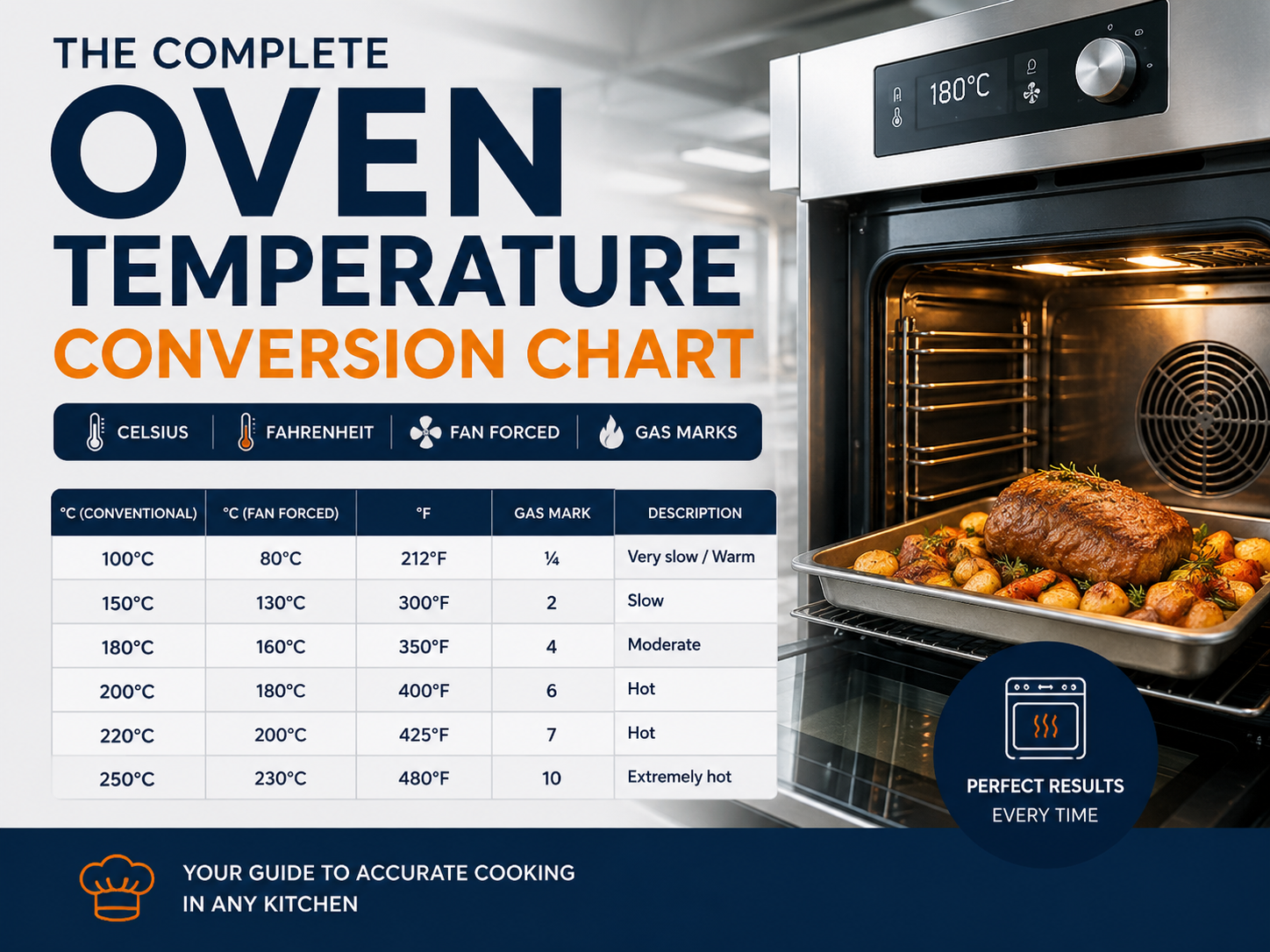
Use this complete oven temperature conversion chart to convert Celsius, Fahrenheit, fan forced temperatures, and gas marks for Australian commercial and home kitchens. Whether you're scaling a recipe for commercial service or adapting an American cookbook, this reference covers every conversion you need.
Oven Temperature Conversion Chart – Celsius, Fahrenheit, Fan Forced & Gas Mark
Fan forced temperatures are typically 15–20°C lower than conventional settings. Use the full chart below as your definitive reference.
| °C (Conventional) | °C (Fan Forced) | °F | Gas Mark | Description |
|---|---|---|---|---|
| 100°C | 80°C | 212°F | ¼ | Very slow / Warm |
| 120°C | 100°C | 250°F | ½ | Very slow |
| 140°C | 120°C | 285°F | 1 | Slow |
| 150°C | 130°C | 300°F | 2 | Slow |
| 160°C | 140°C | 320°F | 3 | Moderately slow |
| 170°C | 150°C | 340°F | 3–4 | Moderate |
| 180°C | 160°C | 350°F | 4 | Moderate |
| 190°C | 170°C | 375°F | 5 | Moderately hot |
| 200°C | 180°C | 400°F | 6 | Hot |
| 210°C | 190°C | 415°F | 6–7 | Hot |
| 220°C | 200°C | 425°F | 7 | Hot |
| 230°C | 210°C | 450°F | 8 | Very hot |
| 240°C | 220°C | 475°F | 9 | Very hot |
| 250°C | 230°C | 480°F | 10 | Extremely hot |
Most Common Celsius to Fahrenheit Oven Conversions
| Recipe Says | Convert To | Notes |
|---|---|---|
| 350°F | 180°C conventional / 160°C fan | Standard baking temperature |
| 375°F | 190°C conventional / 170°C fan | Roasting, pastries |
| 400°F | 200°C conventional / 180°C fan | High-heat roasting |
| 425°F | 220°C conventional / 200°C fan | Very hot — pizzas, bread |
| 450°F | 230°C conventional / 210°C fan | Searing, high-heat items |
| 300°F | 150°C conventional / 130°C fan | Low and slow cooking |
| 325°F | 160°C conventional / 140°C fan | Delicate cakes, custards |
Fan Forced Oven Conversion — How It Works
Fan forced (convection) ovens circulate hot air with a fan, cooking food more evenly and often faster than conventional ovens. When using this oven temperature chart to convert from conventional to fan forced:
- Reduce the temperature by 15–20°C
- Reduce the cooking time by approximately 10–15%
- Check food earlier than the recipe suggests — especially pastries and cakes
- Use lower shelf positions for baking to avoid over-browning on top
Fan Forced vs Conventional: When to Use Each
| Cooking Task | Recommended Setting | Reason |
|---|---|---|
| Roasting meats | Fan forced | Even browning, faster cook |
| Baking cakes | Conventional | Gentler heat prevents cracking |
| Bread and pastries | Fan forced | Crisp crust development |
| Custards & soufflés | Conventional | Fan can cause uneven rise |
| Cookies and biscuits | Fan forced | Multiple trays cook evenly |
| Casseroles | Either | Adjust time if using fan |
Commercial Oven Temperature Considerations for Australian Kitchens
Hospitality Connect supplies commercial ovens to professional kitchens across Australia. Our team works with chefs daily, and oven temperature calibration is one of the most common questions we receive. Here's what to know for commercial equipment:
- Combi ovens: Display Celsius as standard in Australian-spec machines. Always check the manual for calibration tolerance (±5–10°C is normal).
- Deck ovens: Top and bottom heat can be controlled independently. Temperature readings refer to the overall cavity unless specified.
- Convection ovens: All commercial convection ovens use fan-forced heat. Apply the standard 15–20°C reduction when adapting domestic recipes.
- Gas ovens: Use the Gas Mark column from the oven temperature chart above. Australian commercial gas ovens are calibrated in Celsius; gas marks are mainly relevant for older domestic equipment.
Choosing the Right Commercial Oven for Your Kitchen
Understanding your oven temperature conversion chart is only half the equation — the right oven type makes a significant difference to output consistency, speed, and energy efficiency in a commercial kitchen setting.
- Commercial Convection Ovens: Fan-forced heat distribution for even, consistent results across multiple trays. Ideal for high-volume baking, roasting, and reheating. Temperatures typically 15–20°C lower than conventional equivalents.
- Combi Ovens: The most versatile commercial cooking appliance — combines convection heat, steam, and combination modes. Precise temperature control makes them ideal for fine dining and large-scale catering.
- Deck Ovens: Stone or steel deck surface delivers intense, radiant heat from below. The preferred choice for artisan bread, pizza, and pastries requiring a crisp base.
- Gas vs Electric: Gas ovens provide faster heat recovery and lower running costs for high-throughput kitchens. Electric ovens offer more precise temperature control, which is critical when working with exact conversion temperatures.
Equipping a commercial kitchen in Australia?
Hospitality Connect stocks commercial convection ovens, combi ovens, and deck ovens — with expert advice and Australia-wide delivery.
Shop Commercial Ovens →Celsius to Fahrenheit Formula
For precision calculations outside the oven temperature chart above, use these formulas:
°F = (°C × 9/5) + 32
°C = (°F − 32) × 5/9
Example: 180°C × 9 = 1620 ÷ 5 = 324 + 32 = 356°F (rounds to 350°F, the standard baking temperature).
Australian vs US Recipe Temperatures — Key Differences
American recipes almost always use Fahrenheit, while Australian recipes use Celsius. The confusion deepens because many older Australian recipes were written for conventional ovens, but most modern Australian kitchens — especially commercial ones — use fan forced. When following any recipe, check three things: the temperature scale used, whether it's fan forced or conventional, and whether the oven has been calibrated recently. This oven temperature chart for Australia covers all three scenarios.
Frequently Asked Questions
What is 350°F in Celsius?
350°F is 180°C in a conventional oven, or 160°C in a fan forced oven. This is the most common baking temperature in American recipes and the most-searched oven temperature conversion in Australia.
What is 180°C in Fahrenheit?
180°C equals 356°F, commonly rounded to 350°F in US recipes. It's the standard temperature for cakes, biscuits, and general baking in Australian kitchens.
Do I need to adjust cooking time for fan forced oven conversion?
Yes — reduce cooking time by 10–15% when switching from conventional to fan forced at the same temperature, or keep the same time and reduce the temperature by 15–20°C.
Is a fan forced oven the same as a convection oven?
Yes. In Australia the term 'fan forced' and in the US the term 'convection oven' refer to the same technology — a fan circulates hot air inside the cavity for more even, faster cooking.
How do I use a gas mark conversion chart in Australia?
Gas marks are an older UK/European system. Use the gas mark column in the oven temperature conversion chart above to find the equivalent Celsius setting. Most modern Australian commercial kitchens use Celsius directly.


