

Commercial Fridge Temperature Guide: Safe Food Storage in Australian Kitchens
Getting your commercial fridge temperature right isn't optional — it's a legal requirement under Australian food safety law. The wrong storage temperature can mean spoiled product, a failed council inspection, or worse, a food safety incident that harms customers. This guide covers the correct temperatures for commercial refrigeration, what Australian law requires, and what to look for when something goes wrong.
Why Commercial Fridge Temperatures Matter
Commercial refrigeration serves one primary purpose: keeping perishable food out of the temperature danger zone where bacteria multiply rapidly. In a busy hospitality operation, refrigeration failures can cascade quickly — a fridge running slightly warm on a Friday afternoon can render an entire week's worth of prep unsalvageable by Saturday morning.
Beyond food safety, correct refrigeration temperature directly affects:
- Shelf life and waste — Even a 2°C increase above target can significantly reduce the usable life of dairy, meat and prepared foods.
- Compliance — Food businesses in Australia are required under FSANZ Standard 3.2.2 to store potentially hazardous food at or below 5°C.
- Council inspections — Environmental health officers check fridge temperatures as part of routine inspections. An out-of-range fridge is an immediate compliance issue.
- Insurance and liability — Temperature logs are evidence of due diligence in the event of a food safety complaint.
Safe Temperature Zones for Commercial Refrigeration
The temperature danger zone in Australia is defined as 5°C to 60°C. Within this range, bacteria capable of causing food poisoning — including Salmonella, Listeria and Staphylococcus aureus — can double in numbers every 20 minutes under ideal conditions. The longer food spends in this zone, the higher the risk.
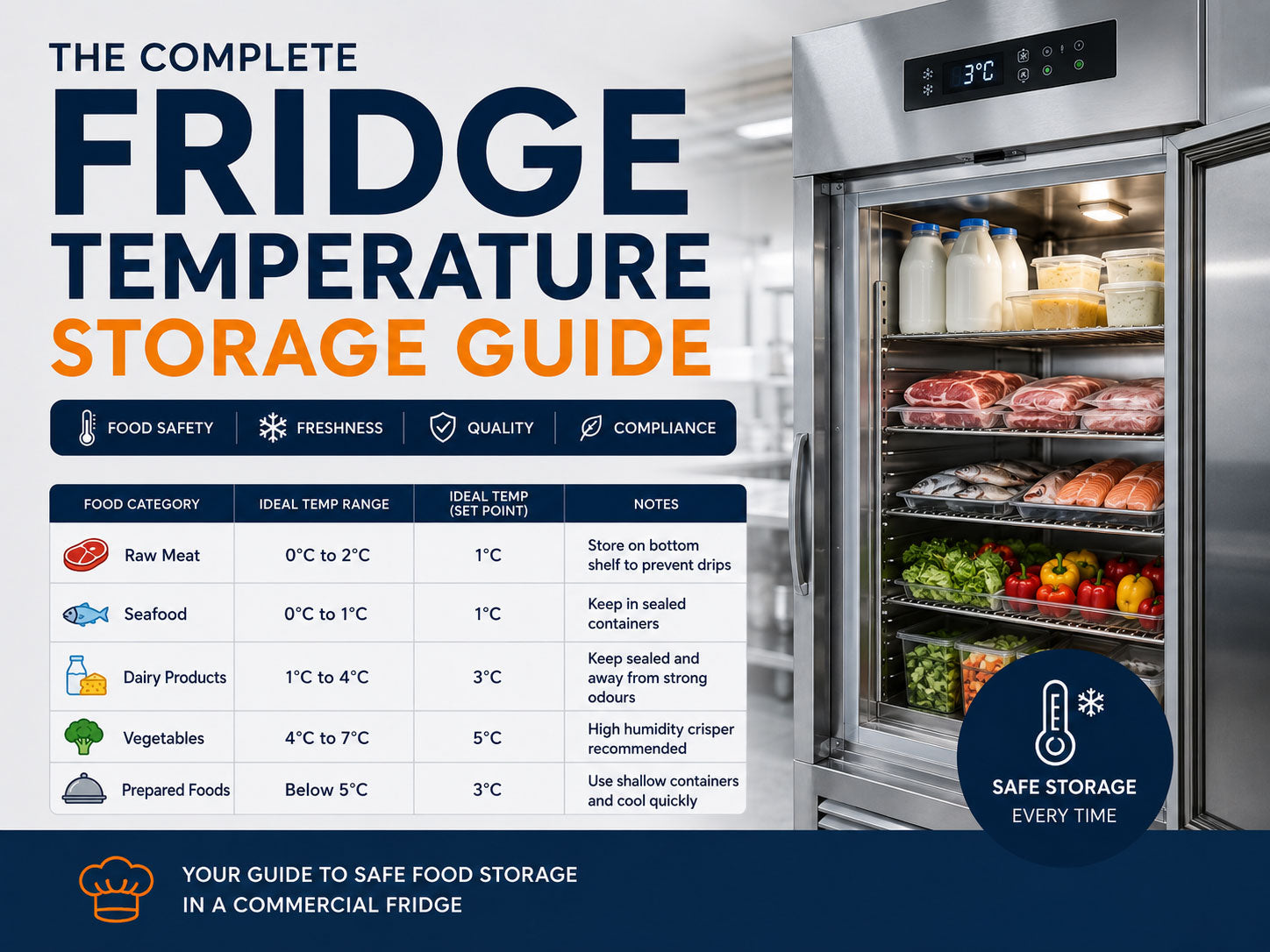
For commercial refrigeration, the target operating range is 0°C to 4°C, with 2–3°C being ideal for most applications. This provides a safety buffer below the 5°C legal maximum, accounting for door openings, loading of warm product and ambient temperature fluctuations.
| Temperature Zone | Range | Status | Notes |
|---|---|---|---|
| Ideal refrigeration | 1°C – 4°C | Safe | Target operating range for most commercial fridges |
| Acceptable maximum | 5°C | Legal limit | FSANZ Standard 3.2.2 maximum for cold storage |
| Danger zone (cold end) | 5°C – 21°C | Risk zone | Bacterial growth accelerates above 5°C |
| Rapid growth zone | 21°C – 47°C | High risk | Fastest bacterial multiplication rate |
| Danger zone (hot end) | 47°C – 60°C | Risk zone | Growth slows but remains active |
| Safe hot holding | 60°C+ | Safe (hot) | Legal hot holding minimum under FSANZ 3.2.2 |
| Freezer | -15°C to -18°C | Safe | Stops bacterial growth; -18°C target for commercial freezers |
Food Storage Temperature Chart
| Food Type | Ideal Storage Temp | Max Safe Temp | Approximate Shelf Life at Ideal Temp |
|---|---|---|---|
| Fresh red meat (whole cuts) | 0°C – 3°C | 5°C | 3–5 days |
| Fresh mince and sausages | 0°C – 3°C | 5°C | 1–2 days |
| Fresh poultry | 0°C – 2°C | 5°C | 1–3 days |
| Fresh fish and seafood | 0°C – 2°C | 5°C | 1–2 days |
| Cooked meats / deli | 1°C – 4°C | 5°C | 3–5 days |
| Dairy — milk | 1°C – 4°C | 5°C | 5–7 days (check use-by) |
| Dairy — cheese (hard) | 2°C – 8°C | 8°C | Weeks to months (check packaging) |
| Dairy — soft cheese / brie | 1°C – 4°C | 5°C | 1–2 weeks |
| Eggs | 4°C – 8°C | 8°C | 3–5 weeks (check use-by) |
| Prepared / ready-to-eat foods | 1°C – 4°C | 5°C | 24–48 hours once opened / made |
| Fruit and vegetables (cut) | 2°C – 5°C | 7°C | 1–5 days depending on type |
| Fruit and vegetables (whole) | 4°C – 10°C | 10°C | Varies widely by product |
| Sauces, stocks, soups (cooked) | 1°C – 4°C | 5°C | 3–4 days |
| Beverages (non-dairy) | 2°C – 8°C | 10°C | Per label / use-by |
Note: Always observe the use-by or best-before date. The shelf life figures above assume correct temperature and proper storage practices. First In, First Out (FIFO) rotation is mandatory.
HACCP Food Safety Considerations
For businesses operating under a HACCP-based food safety plan, refrigeration temperature is a Critical Control Point (CCP). This means it requires documented monitoring, corrective action procedures and verification records.
Minimum HACCP requirements for commercial refrigeration typically include:
- Temperature monitoring frequency — At minimum, twice daily (start of service and close). High-risk operations may require continuous digital monitoring.
- Temperature logs — A written or digital record of fridge temperatures with date, time and staff initials. This is your evidence of compliance for council inspections.
- Corrective action procedure — A documented process for what happens when a fridge exceeds 5°C. This must include assessment of affected food, escalation process and maintenance contact.
- Calibration of thermometers — Probe and ambient thermometers used for monitoring must be calibrated regularly. Keep records of calibration dates.
- Cold chain on delivery — Incoming goods must be checked for temperature compliance on receipt. Refrigerated deliveries should arrive at 5°C or below. Record delivery temperatures.
Signs Your Fridge Temperature Is Wrong
| Warning Sign | Possible Cause | Immediate Action |
|---|---|---|
| Display reads correct but product feels warm | Sensor positioned poorly; actual cavity temp differs from sensor | Check with a calibrated probe thermometer at product level |
| Condensation on door glass or walls | Door seal failing; warm humid air entering cavity | Inspect and replace door seals; check auto-close function |
| Motor running constantly without cycling off | Refrigerant leak; coil icing; ambient temp too high | Call refrigeration technician; monitor temperatures closely |
| Ice forming on back wall or coils | Auto-defrost malfunction; door being left open; overpacking | Manual defrost; inspect defrost timer or heating element |
| Product freezing near back wall | Temperature set too low; cold air outlet too close to product | Raise set temperature; reorganise product placement |
| Fridge reading above 6°C | Overloading with warm product; failed thermostat; compressor issue | Remove warm product; check compressor; call technician if recurring |
| Unusual noise (clicking, humming, rattling) | Fan blade obstruction; compressor strain; loose components | Clear obstructions; if noise persists, arrange service |
Choosing the Right Commercial Fridge
Not all commercial refrigeration is the same. Matching the right unit to your operation affects temperature performance, running costs and compliance. Key factors to consider:
- Operating environment — Commercial fridges are climate-rated. A unit rated for a cool storeroom may struggle in a hot kitchen without adequate ventilation clearance. Check the climate class (typically SN, N, ST or T) and match to your ambient conditions.
- Capacity and loading pattern — Overloading a fridge restricts airflow and forces the unit to work harder. Allow 20–25% of internal space for air circulation. If you're regularly at capacity, step up to the next size.
- Door type — Solid door vs glass door. Glass doors increase visibility and reduce unnecessary openings, but have slightly higher heat gain. Solid doors offer better insulation for high-access areas.
- Digital vs analogue temperature control — Digital controllers offer more precise temperature setting, built-in alerts and easier calibration. Recommended for HACCP-critical applications.
- Remote monitoring — For multi-site operations or high-value stock, consider units with remote temperature monitoring and alarm capability. Alerts to a phone when a fridge door is left open or temperature exceeds threshold can save significant loss.
Browse Commercial Refrigeration at Hospitality Connect
Upright fridges, underbench units, display refrigeration and more — all meeting Australian food safety requirements for commercial kitchen operation.
Shop Commercial Refrigeration →

