

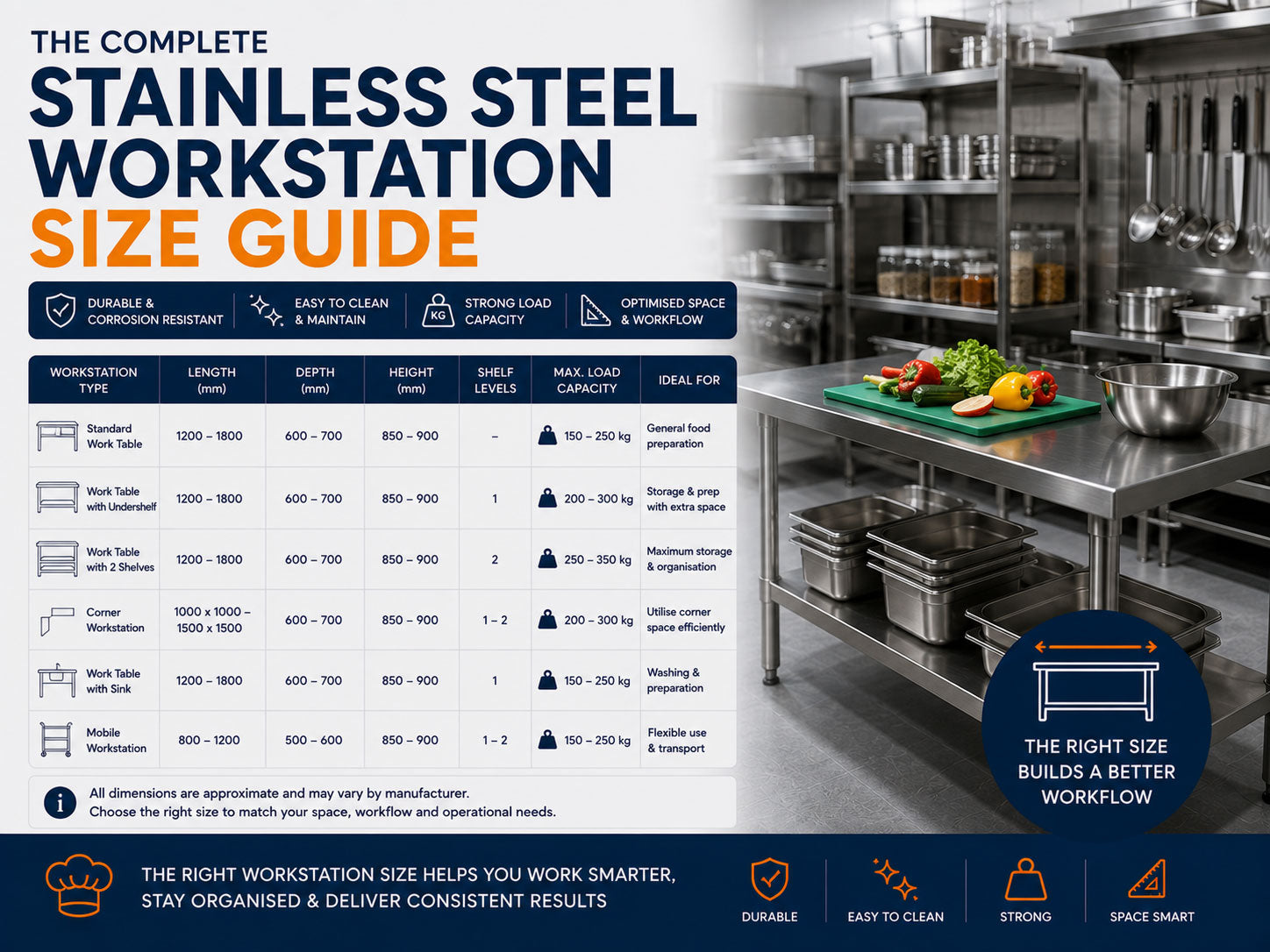
Choosing the Right Commercial Workbench Size
A stainless steel workbench is the backbone of a commercial kitchen. Get the dimensions right and your kitchen runs efficiently. Get them wrong and you'll have staff crammed into tight spaces, poor workflow, and potential food safety issues from inadequate prep surfaces.
This guide covers standard dimensions, space planning requirements and the features that matter when specifying workbenches for a commercial kitchen.
Standard Workbench Dimensions
Commercial workbenches in Australia follow broadly standardised dimensions, though custom fabrication is available for unusual spaces. Here's what's available off-the-shelf:
| Dimension | Standard Options | Notes |
|---|---|---|
| Width (depth front-to-back) | 600mm, 700mm, 800mm | 600mm suits tight spaces; 700–800mm provides better prep area; 700mm is the most common commercial standard |
| Length | 900mm, 1200mm, 1500mm, 1800mm, 2100mm, 2400mm | 900–1200mm for single-person workstations; 1800–2400mm for multi-person prep or dual-task surfaces |
| Height | Standard: 900mm; Adjustable: typically 850–950mm | 900mm is the Australian commercial kitchen standard. Adjustable-leg models suit mixed-height staff or dual-use prep/baking surfaces (pastry work suits lower height ~850mm) |
| Worktop thickness | 0.9mm–1.5mm surface on fabricated bench; solid 25mm options | Heavier gauge (1.2–1.5mm) for chopping and heavy prep; lighter gauge suits light assembly or pass surfaces |
Stainless Steel Grade: 304 vs 430
- 304 stainless (18/8): Contains 18% chromium and 8% nickel. Highly corrosion resistant, non-reactive with food acids, withstands commercial cleaning chemicals. This is the food-safe standard for all food contact surfaces and is required by AS 4674 (construction and fitout of food premises).
- 430 stainless (ferritic): Contains 16–18% chromium, no nickel. Lower cost but significantly less corrosion resistant — particularly susceptible to chloride attack from cleaning chemicals and salty foods. Suitable for non-food-contact structural components only.
Space Planning and Workflow Considerations
Dimensions alone don't create an efficient kitchen. How benches are positioned determines how well your team can work.
Aisle and Clearance Requirements
| Scenario | Minimum Clearance | Recommended |
|---|---|---|
| Single-person work aisle (one side benched) | 900mm | 1,000–1,050mm |
| Two-person pass aisle (benches both sides) | 1,200mm | 1,350–1,500mm |
| Aisle with trolley/rack movement | 1,200mm | 1,500mm |
| Oven door swing clearance opposite bench | Equipment door width + 600mm | 1,200mm from oven face to opposite surface |
The Work Triangle Principle
Kitchen design has long used the work triangle concept — the three most-used zones (prep, cooking, service) should form a tight triangle with minimal crossover. In a commercial context, this translates to:
- Prep bench positioned close to cold storage (refrigerator or coolroom)
- Direct sightline or short path from prep bench to cooking equipment
- Pass or plating bench positioned at the service end without crossing the cooking zone
Even if your kitchen doesn't allow a perfect triangle, the principle is the same: minimise the distance food travels between prep, cook and service, and eliminate cross-traffic between zones.
Zone-Based Bench Planning
| Kitchen Zone | Recommended Bench Length | Recommended Width | Key Features |
|---|---|---|---|
| Cold prep (salads, garnish) | 1,200–1,800mm | 700mm | Underbench refrigerator, splashback, cold well integration |
| Meat / protein prep | 1,500–2,400mm | 700–800mm | Separate from other prep zones; splashback; underbench storage or dedicated to chopping boards |
| Pastry / baking prep | 1,800–2,400mm | 800mm | Solid surface preferred; lower height (850mm) for rolling dough |
| Pass / plating surface | 1,200–2,400mm (to service span) | 600mm | Heat lamp positioning; pass-through design; may integrate heated holding |
| Dish drop / soiled | 900–1,200mm | 600–700mm | Proximity to dishwasher; stainless finish for water resistance |
Workbench Features to Consider
- Undershelf: A solid or slatted stainless undershelf provides critical storage in a tight kitchen. Solid shelves suit dry storage; slatted allows visibility and airflow. Most commercial benches include an undershelf as standard.
- Splashback: A 150–300mm upstand at the rear protects walls from splatter and is required by most health departments where the bench is adjacent to a wall. Integrated splashbacks (welded, not screwed) are easier to clean.
- Sink integration: Prep-sink benches (one or two-bowl) save space and maintain workflow within the prep zone. Check local council requirements for the number of hand wash basins required separately.
- Drawer units: Underbench drawers on full-extension slides suit tool and utensil storage. Specify commercial-grade slides rated for 40–50kg load.
- Lockable cupboard base: Suits chemical storage (below and away from food prep) or secure equipment storage.
- Castors vs fixed feet: Castors suit benches that need to be moved for cleaning or reconfiguration. Fixed adjustable feet suit permanent installations — easier to level on uneven floors.
Common Buying Mistakes
- Measuring the gap, not the workflow: A bench might physically fit a space but position prep too far from cooking equipment. Measure workflow distances, not just floor space.
- Buying 430 grade for food prep surfaces: Lower cost upfront, higher risk of corrosion, staining and compliance issues. Specify 304 for any food contact surface.
- Ignoring height requirements: 900mm is standard, but if your staff is significantly shorter or taller, adjustable-leg models prevent ergonomic injury over a long service.
- Underestimating bench length: The most common complaint from chefs is not enough bench space. If in doubt, go longer — a 1,800mm bench is rarely too long; a 1,200mm bench is frequently too short.
- Not accounting for equipment that sits on the bench: A mixer, slicer, or food processor on a 1,200mm bench leaves very little usable prep space. Plan for equipment footprints when specifying bench length.
What to Look for When Buying
- 304 grade stainless on all food contact surfaces — verify, don't assume
- Welded construction for main joints rather than bolted (easier to clean, more hygienic)
- Adjustable feet with 50mm+ travel to accommodate uneven floors
- Leg gauge: 38–50mm square or round legs are standard for light to medium duty; 50mm+ for heavy-duty benches
- Lead time and availability: Standard sizes are usually ex-stock; custom fabrication typically 2–4 weeks
Browse Commercial Stainless Steel Workbenches
Hospitality Connect stocks a full range of 304-grade stainless workbenches in standard sizes — with undershelves, splashbacks and sink options available.
Shop Workbenches →

