

Buying guide · Staffed popcorn stations
Choose a commercial popcorn machine for the portions you must hand over during your busiest service window—not simply for the ounce label on its kettle.
The short answer
Choose the smallest verified machine whose usable prepared stock and replenishment can cover your peak, while staff still have time to bag and serve. Consider 4 or 8 oz for smaller, frequent batches; investigate 12 or 16 oz when a demonstrated larger batch or pre-peak preparation would solve a production shortfall.
Those are shortlist directions, not venue-size rules. A bigger kettle will not fix slow bagging, an unsuitable holding arrangement or a counter that cannot accommodate the machine.
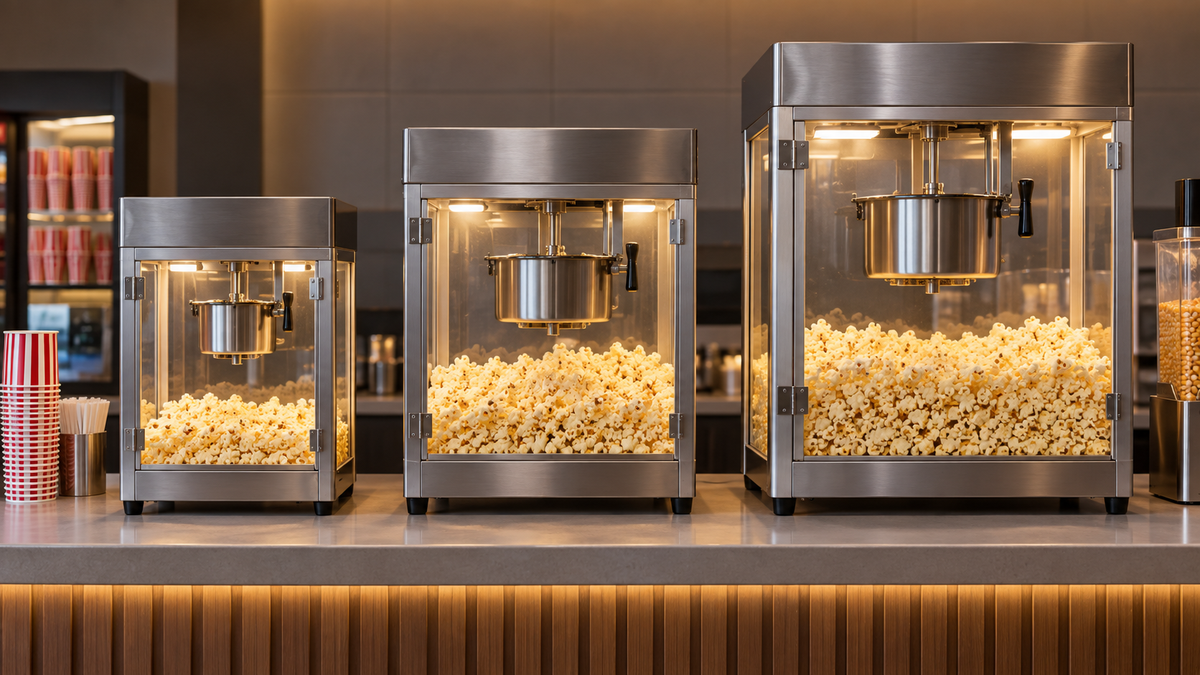
Image above: illustration only. These are not verified Paragon models, measured capacities or a scale comparison.
1. Turn your peak into finished-product demand
Weigh the finished popcorn in the portion you actually intend to sell. Record how many portions customers need, over what interval, and how much acceptable stock can be prepared beforehand under your venue’s food-safety and quality plan.
Worked example: 60 portions in 15 minutes
Total demand: 60 × 25 g = 1,500 g, or 1.5 kg of finished popcorn.
Prepared stock: 40 portions’ worth × 25 g = 1,000 g, provided that preparation and holding are acceptable under the venue’s plan.
Replenishment during the rush: the remaining 20 portions require 500 g of usable finished popcorn within that 15-minute window.
Portion sensitivity: at 40 g rather than 25 g, the same 60 sales require 2.4 kg. Recalculate the prepared stock and replenishment too; do not carry over the 500 g figure.
This is demand arithmetic, not a kernel charge, a batch yield or proof that any 4, 8, 12 or 16 oz model passes. The replenishment must be ready when needed—not merely finished at the end of the interval—and staff must hand over all 60 portions.
2. Keep five different capacities separate
Nominal kettle size: the 4, 8, 12 or 16 oz designation is a kettle/batch label. It is not the finished weight of popcorn available to sell. Confirm the permitted ingredient charge and recipe in the exact model’s manual.
Usable finished batch: weigh the acceptable popped product available for portioning after a representative batch. Do not assume a kernel-to-popped expansion ratio.
Hourly benchmark: a manufacturer’s maximum one-ounce servings per hour is a comparison reference, not your measured portions per hour. Dividing it by four does not prove performance during a 15-minute rush.
Usable cabinet stock: the cabinet must hold the intended prepared stock with practical scoop access and acceptable product quality. Its appearance or external dimensions do not establish that usable quantity.
Staffed station throughput: loading, popping, dumping, recovery, portioning and handover share time and space. The complete workflow must meet the peak, even when the kettle itself has enough output.
3. Build a conditional 4–16 oz shortlist
Compare the four Paragon kettle-machine sizes listed in the Hospitality Connect commercial popcorn machine range. The collection also lists three Lékué microwave accessories; these are a different format, not three additional equivalent kettle machines.
The figures below are advertised maximum US manufacturer benchmarks in one-ounce servings per hour. They are not verified output for the Australian-supplied variants or guaranteed staffed-counter throughput. Confirm the exact Australian model and output basis with the supplier.
Paragon TP-4 oz Theater Pop
Start here when smaller, frequent batches suit the demand pattern and measured replenishment can keep up. Keep it on the shortlist only if its demonstrated usable batch, cabinet stock and shared production/serving workflow meet your peak.
US reference: Paragon’s 4 oz manufacturer page advertises a maximum of 92 one-ounce servings/hour.
Paragon Theatre Pop 8 oz
Compare this with the 4 oz option if frequent batches remain appropriate but the smaller model’s observed replenishment is insufficient. Ask whether the larger usable batch actually improves the rush without creating unwanted held stock.
US reference: Paragon’s 8 oz manufacturer page advertises a maximum of 147 one-ounce servings/hour.
Paragon Theatre Pop 12 oz
Investigate this size when a verified larger batch or planned preparation before the peak could close a demonstrated supply gap. Confirm the exact Australian model and its documented output basis before treating it as a step up in your station.
US reference: Paragon’s 12 oz manufacturer page advertises a maximum of 221 one-ounce servings/hour.
Paragon Theatre Pop 16 oz
Consider this when measured demand makes larger-batch production useful and the venue can accommodate its verified operating envelope. Do not choose it merely because it has the largest label: stock quality, serving access and operator time still have to work.
US reference: Paragon’s 16 oz manufacturer page advertises a maximum of 295 one-ounce servings/hour.
4. Test production and serving together
Ask for a supplier demonstration of the exact proposed Australian model, using your intended ingredients, recipe, portion container and staffing arrangement. Record:
- Finished output: usable finished mass from each batch, excluding product that cannot be served.
- The full production loop: actual load, pop, dump and recovery time, including operator handling. Record initial warm-up separately; do not substitute a standard cycle assumption.
- Serving performance: time to portion, bag and hand over the required sales while production continues, with the staff actually planned for service.
- Prepared-stock quality: usable cabinet quantity, scoop access, texture and acceptability under the venue’s holding and food-safety plan. Do not infer a holding duration from a warming feature.
For the worked example, demonstrate that the initial 40 portions’ worth can be prepared and held acceptably, that another 500 g becomes available as needed, and that all 60 portions can be served in 15 minutes.
If production falls short, compare a larger verified batch or a different permitted preparation plan, then repeat the trial. If popcorn is available but bagging falls behind, test serving layout, packaging access or staff allocation before upsizing. If holding quality fails, reconsider the prepared quantity and batch pattern rather than relying on more cabinet stock.
5. Check the whole station, not just the footprint
Allow room to operate and replenish
Obtain dimensions and required clearances for the actual supplied model. Check open-door travel, kettle loading and dumping, cleaning access and service access. Add space for ingredients, portion containers, scoops, bagging, waste and staff movement; those jobs cannot all occupy the machine’s closed footprint.
For a benchtop installation, confirm operating weight and suitable support. If a cart or stand is preferable, request a supplier-matched option and verify its support and operating arrangement. Check the delivery and loading route, doorways, thresholds and final placement before ordering.
Verify Australian electrical requirements
Request the exact Australian model identification, nameplate information and installation manual. Have an appropriately licensed electrical professional check the required connection, circuit capacity and other loads at the proposed location. A US specification or an existing outlet does not establish that the local machine and site are compatible.
Plan holding and cleaning from documentation
If extra holding equipment is proposed, obtain written compatibility for popcorn and your recipe. Do not assume a generic humid hot-food cabinet is suitable simply because it keeps food warm.
Obtain the model-specific shutdown, cooling, isolation, cleaning and reassembly instructions, including compatible cleaning products and removable parts. Check access, replacement parts and local service support; use the manual and venue plan rather than a universal cleaning timetable.
6. Send a complete supplier enquiry
Here is a completed hypothetical enquiry. The station allowance is an example venue measurement—not a Paragon product dimension, required clearance or confirmation that a model fits. Replace these example inputs with your own measured brief.
Subject: Popcorn station for 60 portions in 15 minutes
Please recommend a documented Australian Paragon model for a staffed club popcorn station. Peak demand is 60 portions in 15 minutes at 25 g of finished popcorn each: 1.5 kg total.
The plan allows 40 portions’ worth, or 1 kg, prepared before the rush only if acceptable under the venue’s food-safety and quality plan. That leaves 500 g to produce during the peak. One operator is planned to produce, bag and hand over the portions; please demonstrate that combined workflow, not just kettle output.
Venue input for this hypothetical example: measured available benchtop space is 1,200 mm wide × 750 mm deep, with 1,000 mm clear height above the bench. These are venue-space inputs, not machine dimensions. Please check the complete operating envelope, open-door and kettle access, required clearances, bench support, ingredient and bagging space, waste position and delivery route. Please identify a supplier-matched cart alternative if the benchtop arrangement is unsuitable.
Please demonstrate usable finished batch mass, full load/pop/dump/recovery timing, replenishment availability and portioning/handover time with the intended recipe and packaging. Include the proposed prepared-stock arrangement and its quality assessment. This demand calculation does not establish that any kettle size passes.
Please supply the exact Australian model/part identification, output basis, dimensions, operating weight, installation and cleaning manuals, and electrical requirements for review by the venue’s licensed electrical professional.
Please provide an itemised AUD quotation showing GST treatment, equipment and accessory inclusions, any matched cart/support, scoops and portion packaging, delivery/access or assembly charges, warranty terms, replacement-parts availability and service arrangements. Identify exclusions and confirm current supply details in the quotation.
7. Take the shortlist to a verified purchase
Measure first: weigh your finished portion, count the real peak and measure the available operating space.
Compare on evidence: shortlist the relevant kettle sizes, obtain exact Australian-model documents and arrange the combined production-and-serving demonstration.
Request a complete station quote: contact Hospitality Connect with your popcorn demand and site brief. Resolve output, holding quality, fit and electrical questions before selecting the machine and compatible supporting supplies.


