

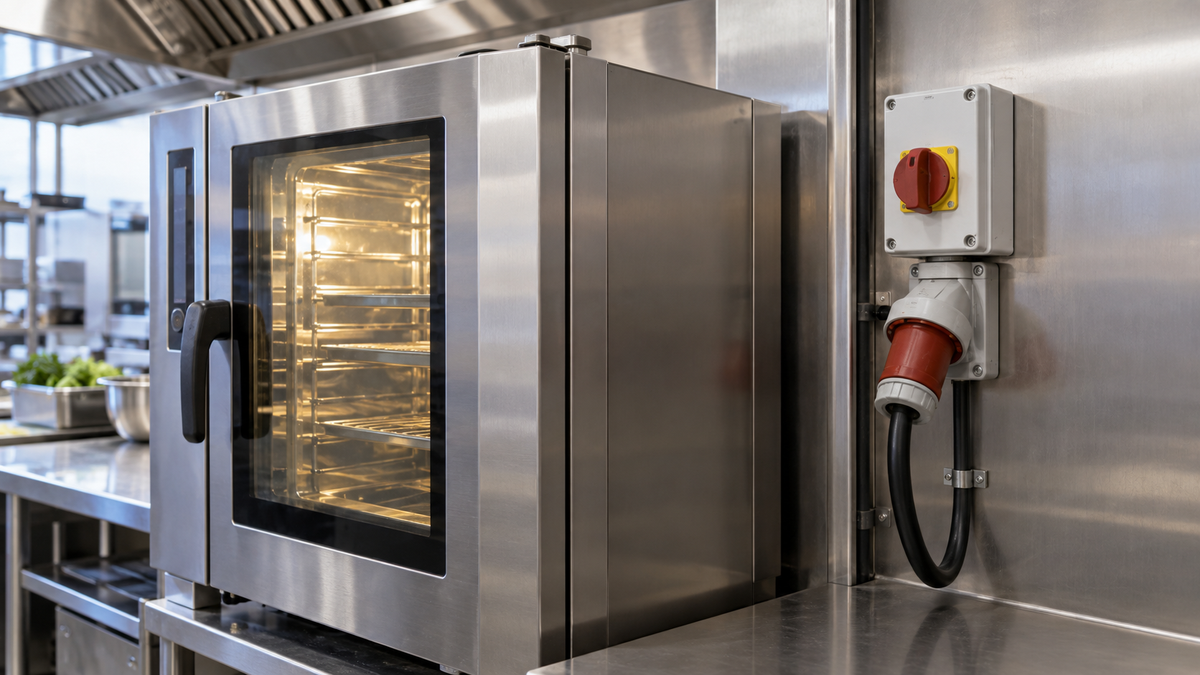
A three-phase requirement belongs to the exact appliance model and supply variant—not its category, plug colour, physical size or your venue’s size. Before ordering, collect the manufacturer’s electrical data, have the supplier confirm the Australian unit being quoted, and obtain an appropriately licensed electrician’s site assessment. Single-phase equipment can still require substantial circuit or site work.
Use one record per appliance below. The aim is a reconciled purchasing package, not an operator-designed electrical installation.
Why similar model names are not interchangeable
The Moffat Blue Seal manual 248336-3, September 2024, printed page 7 lists these contrasting examples:
- IN511R3: 230–240 Vac; 1P+N+E (single-phase); total electrical input 3.5 kW.
- IN511R5: 400–415 Vac; 3P+E (three-phase); total electrical input 5.0 kW.
These are dated document examples, not confirmation of any currently offered SKU, suffix, serial number or country variant. Specifications can change. The manual limits its instructions to appliances carrying the relevant country code, prioritises serial-plate electrical data and directs discrepancies to the manufacturer or authorised representative. Ask the supplier for country-appropriate documents and confirmation of the actual supplied unit.
Copy this electrical equipment schedule for each appliance
Duplicate this card for every proposed appliance. Fill brackets from identified documents; write unknown rather than calculating or guessing missing data.
- Location and asset label
- Kitchen position [ ]; project asset ID [ ].
- Exact identity
- Brand [ ]; complete model and suffix [ ]; Australian supplier SKU [ ]; supplier [ ].
- Australian supplied electrical data
- Voltage [ V ]; phase/type [ ]; frequency [ Hz ]; source [ ].
- Total input and stated current
- Total electrical input [ kW ]; stated current [ A, including its published basis and each line label ]; source [ ].
- Document evidence
- Manufacturer manual/data reference and revision [ ]; supplier-provided serial-plate evidence/reference [ ]; confirmation date [ ].
- Supplied connection and inclusions
- Supplier-confirmed connection method [ ]; included items [ ]; excluded items [ ]; written reference [ ].
- Quantity and service pattern
- Quantity [ ]; menu duty/service period [ ]; concurrent appliances [ ]; background equipment [ ].
- Site-readiness assessment
- Electrician/assessment owner [ ]; documented premises supply [ ]; result and conditions [ ]; report reference/date [ ].
- Quote record
- Equipment quote/reference [ ]; electrical/site quote/reference [ ]; itemised scope [ ]; AUD amounts and GST basis [ ]; exclusions/expiry [ ].
- Questions, status and revision
- Unresolved questions [ ]; action owner/due date [ ]; status [ ]; schedule revision/date [ ]. Default unresolved items to HOLD.
Preserve multi-line current exactly for the electrician; never sum or convert phase currents into a circuit size. Use supplier-provided, safely obtained documents. Do not move equipment or open covers to obtain plate evidence. Leave premises investigation to the electrician.
Who resolves each part?
The supplier resolves the exact supplied model, documents and inclusions. An appropriately licensed electrician assesses the premises and owns circuit, protection and connection design, installation and verification under applicable Wiring Rules and jurisdiction requirements. The venue coordinates access, landlord arrangements and timing.
Standards Australia identifies AS/NZS 3000:2018 as the Wiring Rules for designing, constructing and verifying electrical installations. NSW requires an electrical licence or certificate for electrical wiring work; check local licensing requirements elsewhere. This checklist does not assess or certify your premises.
Seven checks before committing to the order
-
Confirm the complete identity
Evidence: supplier-confirmed model, suffix and Australian SKU appear on the dated quote and schedule. Shorthand or missing suffix: HOLD and request a corrected written identification.
-
Reconcile the electrical data
Evidence: manufacturer documents, supplier confirmation and available plate evidence agree. Conflicting figures or revisions: HOLD for supplier/manufacturer reconciliation; do not choose whichever figure suits the site.
-
Record the supplied arrangement
Evidence: written confirmation covers the Australian supply variant, connection method and inclusions. Unknown connection details: HOLD for supplier clarification rather than assuming an accessory will resolve them.
-
Obtain a site-readiness assessment
Evidence: the electrician’s dated assessment records premises supply, nominated appliances and concurrent/background loads. A spare outlet, three-phase tenancy supply or old-unit match establishes neither spare capacity nor a usable circuit. Missing assessment: HOLD.
-
Compare complete commercial scope
Evidence: itemised equipment and electrical/site quotes identify GST basis, inclusions, exclusions, validity and lead times. Allocate delivery, installation and verification responsibilities. Unpriced required work: HOLD for revised scope, not a headline appliance price.
-
Resolve access, approvals and programme
Evidence: the venue records access arrangements, applicable landlord consent and agreed delivery/site-work dates. Unresolved approvals or dependencies: HOLD, assign an owner and confirm the programme before committing.
-
Hand over one final revision
Evidence: supplier and electrician hold the same final schedule and documents; the venue records accepted commercial scope. Unapproved substitution: HOLD and restart affected checks. After delivery, reconcile unit paperwork and obtain installer handover before operation; discrepancies return to HOLD.
Hold a mismatched quote: worked example
Hypothetical only: a quote names cooktop KT-1-S, but its attached sheet names KT-1-T with a different supply description. These are invented model labels. Status: HOLD. The supplier must reconcile the exact Australian SKU and issue revised written data and quote; the electrician must reassess that revised package before ordering.
The site brief lists both the cooktop and proposed oven during dinner service, plus refrigeration, warewashing and extraction background loads. Listing them does not establish available capacity; this is not a load calculation.
Which purchasing option is ready to compare?
Shortlist by menu duty from combi ovens, induction cooktops or commercial fryers, then apply the same checks to each exact unit.
- Current site feasible: compare confirmed installed quotes, documented model suitability for menu duty, inclusions and timing—not phase labels alone.
- Upgrade required: evaluate cost and programme dependencies, including landlord or network questions where relevant. Review alternative models with supplier and electrician; a different variant restarts affected checks.
- Data missing or conflicting: keep the purchase on HOLD. Neither single-phase nor three-phase is a universal winner.
Send your completed schedule, shortlist and open questions to Hospitality Connect for model documents and an itemised equipment supply quote. Arrange your electrician’s separate site assessment; supplier confirmation does not approve the premises.


