

Start with your current trainer’s equipment list and any existing tools they approve. Buy a bundle only when its knife types and sizes match that list and you can confirm protection for the complete kit. Otherwise, buy the individual missing items. A larger piece count does not necessarily make a better apprentice chef knife kit.
The purchasing job is to match each required tool to an exact item, then add fitted blade guards, a suitable carry case and an approved maintenance method. Course acceptance, physical protection and permission to carry knives on a particular journey are separate questions.
What must your trainer approve before you buy?
Ask your campus or trainer for the list for your actual course and intake: required versus optional tools, blade types and lengths, acceptable alternatives, maintenance equipment and case requirements. Have tools you already own assessed before replacing them. Ask which specialist items can wait until the relevant training tasks begin.
There is no universal TAFE starter list. For example, the Central Regional TAFE 2026 SIT30821 pre-enrolment guide advises, but does not require, students to bring some of their own equipment. Its suggestions include a 21 cm chef knife, paring knife, peeler, plastic bowl scraper, sharpening steel and tool bag, roll or toolbox, ideally lockable. Uniform requirements are separate. That advice belongs to that provider document; it does not establish requirements for another campus or intake.
Which knives do you need, and which can wait?
Match the function first, then the trainer-approved size and exact model. A useful starting distinction is:
- Cook’s or chef’s knife: general preparation such as chopping vegetables and slicing boneless ingredients. Choose a manageable blade within your trainer’s accepted specification, not simply the longest option.
- Small paring knife: detail work and small trimming tasks where a larger blade is unsuitable.
- Serrated bread knife: crusted slicing when that task or knife is required. A utility knife is not an automatic substitute.
- Boning or filleting knife: specialist meat or fish preparation. Buy the specified type when your training tasks require it; inclusion in a bundle is not itself a reason to buy it now.
- Utility knife: a possible intermediate tool if your trainer wants one, not a substitute for every missing knife on the list.
For handle choice, look for a secure, comfortable grip and a size and weight you can control. Where a trial is available, use a trainer-approved, controlled demonstration rather than touching the cutting edge to test sharpness. A brand name, hardness figure or forged construction alone does not establish suitability for your hands or course.
What does the advertised piece count actually include?
Read an itemised contents list, not just the set name. The Australian manufacturer’s Victorinox Apprentice Kit, SKU 74198, lists a 22 cm cook’s knife, 20 cm filleting knife, 15 cm curved boning knife, 10 cm paring knife and 6 cm shaping knife, plus a Rex peeler and ChefTech case. That is seven items but five knives. Its listed contents do not include a sharpening steel or separate blade guards. This manufacturer example does not establish HC availability, course approval or protected-tool fit.
HC’s Scanpan three-piece listing explicitly names a 9 cm paring knife, 15 cm utility knife and 20 cm chef’s knife. By contrast, the selected native description for Vogue Three Knife Set SA613 does not itemise its knives or sizes. Ask for the exact contents before comparing that set; do not infer them from “three knife”.
A household knife block, steak-knife set or empty bag is not a complete course kit merely because it has enough pieces or pockets. Compare knife sets by their actual inclusions, then account separately for anything absent or unconfirmed.
Worked example: bundle plus missing items, or individual knives?
Hypothetical example only: suppose a trainer has approved a list of a 20 cm chef’s knife, 9 cm paring knife and 23 cm serrated bread knife. This is not an actual TAFE list, and no already-owned approved tools are assumed.
Against that example, the Scanpan three-piece chef set matches the named chef’s and paring knife types and lengths, subject to the trainer accepting the exact models. The 15 cm utility knife is an extra; the required 23 cm serrated bread knife is still missing.
- Bundle route: quote the Scanpan set plus an approved 23 cm serrated bread knife. Count the utility knife as an unneeded extra for this example, not as completion of the list.
- Individual route: quote only the approved 20 cm chef’s, 9 cm paring and 23 cm serrated bread knives. This avoids the extra utility knife and allows a different approved handle or model for each task.
Both routes still need properly fitted guards for all three required blades, an exact carry case, a trainer- and manufacturer-approved maintenance tool, and any separately required peeler, scraper or thermometer. If you also carry the extra utility knife, protect it and include it in the case-fit check. A block or bag in a bundle does not close a missing-knife or guard gap.
Choose the bundle route only if the exact knives are accepted and its complete delivered cost and useful inclusions make sense compared with individual purchases. Include the unused extra and any split-delivery charges in that comparison. If contents or compatibility remain unknown, pause rather than treating the cheaper headline price as a complete offer.
Will the guards and carry case fit the actual tools?
Choose protection around the knives you will actually carry. A blade-length label or pocket count cannot establish fit.
- Guard fit: confirm that each guard covers the entire cutting edge and tip, accommodates the actual blade height and thickness as well as length, and stays secure. Have fit demonstrated safely without touching the edge. “Universal” is not proof of fit for your knife.
- Pocket fit: compare each slot’s usable dimensions with the full guarded knife, including its handle. Check the maintenance tool’s full length and its own containment too, not only the longest blade.
- Closed-case fit: the loaded roll or case must close without forcing tools into place, pressing tips through material or leaving loose items. Confirm how the actual closure and tool retention work with the complete load.
Two catalogue examples show why confirmation matters. The Vogue seven-compartment case is listed at 380 × 225 × 40 mm overall; those are not internal pocket capacities or approval for a particular kit. The selected Chef Works seven-pocket wrap description says its closure “typically” uses a zipper or buckle, which does not verify the actual supplied closure or a lock.
Use the knife guards, cases and bags range to shortlist options, then request itemised guarded-fit confirmation for the exact models. If documentation or physical fit remains unresolved, pause the purchase and ask the supplier and trainer to resolve it.
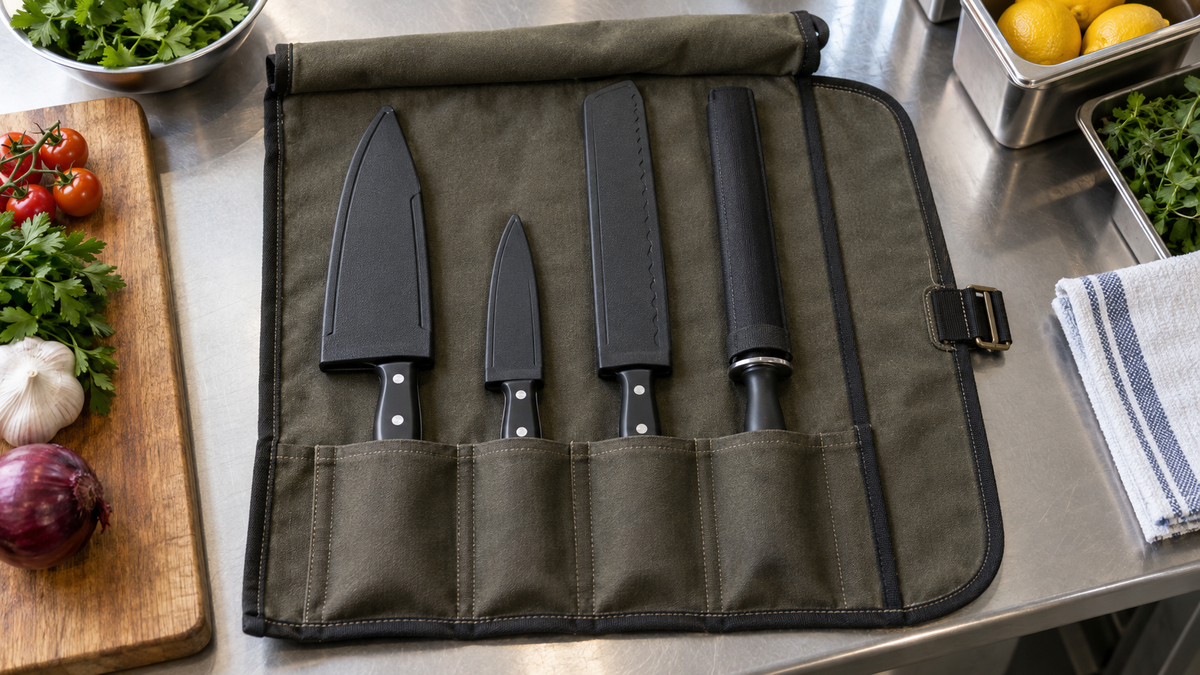
The accompanying illustration shows an open roll with three covered knife-shaped blades and a covered maintenance-tool-shaped item. It is not a verified brand, model or course kit, and does not demonstrate closure, puncture protection or fit.
Which maintenance equipment should you include?
Ask your trainer to approve a maintenance method compatible with each exact blade and edge, using the knife and tool manufacturers’ instructions. Do not assume one steel, stone or sharpener suits every knife, including a serrated bread knife. Select from knife sharpeners and steels only after that compatibility is established.
Request the relevant manufacturer care instructions for cleaning, drying and secure storage, and arrange supervised training in the approved method. This is a purchasing decision, not a sharpening tutorial: angles, strokes and maintenance frequency must come from the applicable instructions and training, not a generic kit recommendation.
The UK HSE’s kitchen knife safety guidance supports general principles: use a knife suited to the task, train people in safe use and sharpening, keep knives sharp, use a stable cutting surface, take care when washing and store knives securely in a scabbard or container. It is UK safety guidance, not Australian law or permission to commute with knives.
What belongs in a complete delivered AUD quote?
Ask for two itemised options where useful: bundle plus approved missing items, and individual required tools. Each quote should identify:
- Exact knife SKUs, types, blade lengths and quantities, including missing required knives and any unneeded bundle extras.
- A fitted guard for each blade being carried, the exact carry case, and written confirmation of guarded-tool and maintenance-tool fit.
- The approved maintenance tool and any course-specific peeler, scraper, thermometer or other required equipment.
- Availability and cost of replacement guards and relevant replacement parts, with optional spares clearly separated from the initial purchase.
- Manufacturer care instructions supplied, the approved maintenance method, and what training the trainer will provide versus any supplier support or charge.
- AUD item prices and totals clearly marked GST-inclusive or GST-exclusive, GST amount, freight and the final delivered total.
- Written inclusions and exclusions, lead time, delivery arrangements and return conditions, including how a fit problem would be handled before tools are used.
Use the delivered total for comparison, not the set price alone. No actual price or stock position is established by the examples here.
A completed supplier enquiry
The following message uses the hypothetical three-knife list above; replace that list with your own trainer’s confirmed requirements before sending.
Hello Hospitality Connect, I am comparing a kit purchase using this hypothetical trainer-approved list: a 20 cm chef’s knife, 9 cm paring knife and 23 cm serrated bread knife. Please assume no already-owned approved tools for this comparison. Could you quote the Scanpan three-piece set plus an approved matching bread-knife option, alongside an individual-knives option, stating exact SKUs, blade lengths and all inclusions? Please identify the extra utility knife separately; I will obtain trainer acceptance of the proposed models before ordering.
Please include properly fitted guards for the three required blades and an exact carry case. Confirm full edge and tip coverage and fit to each blade’s height, thickness and length, plus usable pocket dimensions and closure with the full guarded knives, handles and maintenance tool inside. Please identify a maintenance tool and method supported by the knife and tool manufacturers for trainer approval, supply the care instructions, and separate any peeler, scraper or thermometer that would need adding if my final course list requires it.
Please provide an itemised AUD quote showing GST treatment, freight and final delivered totals for both options, optional replacement guards or parts, and any support or training inclusions and exclusions. Before I order, please confirm lead time, delivery arrangements, return conditions and how unresolved fit would be checked without using the tools. I will provide my delivery postcode and required date for the final freight and timing confirmation.
Before ordering or travelling
First obtain your current training list and approval for any existing tools. Then use the matching example to request a complete quote, and resolve every missing item and protection-fit question before ordering.
Course approval and a physically protective case do not establish permission to carry knives in public or on transport. Obtain current local legal and knife-sale requirements, transport-operator rules and campus policy applicable to you before buying or travelling. A lock or student ID does not by itself prove a journey is lawful, and this guide does not determine that question.
Source and catalogue examples checked 25 October 2026. Provider advice and model contents are limited to the named documents and listings; reconfirm them for your purchase.


