

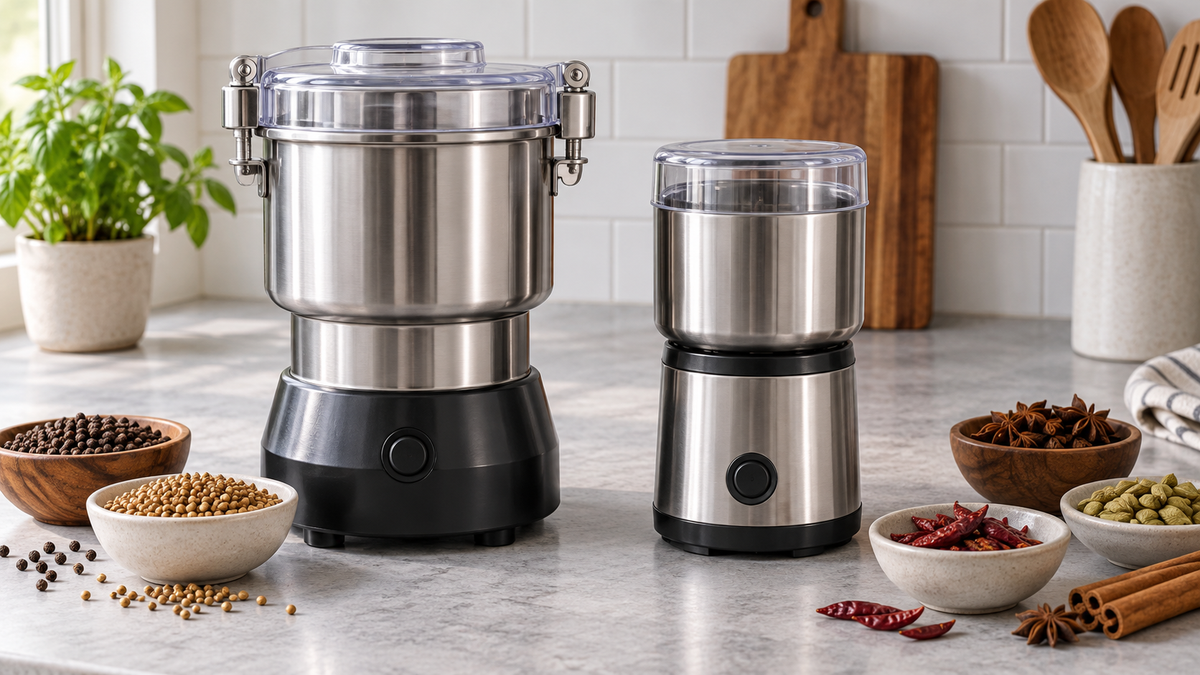
Choose a manual mill for small finishing quantities, an electric batch-blade grinder for repeated weighed dry blends, or a disc/hopper grinder for larger dry runs. For wet paste, choose only a supplied model documented for that task. These formats are not interchangeable: the buying decision is whether the permitted load reaches your target texture within the staffed prep window, including cleaning and changeovers.
Illustration note: the larger and smaller countertop grinders shown are illustrative, not verified models, capacities or a scale comparison.
Which grinder format suits the job?
Manual mill: finishing rather than production batches
Hand turning drives the grinding mechanism to deliver small amounts, such as cracked pepper at the pass. Ingredient suitability and texture adjustment depend on the mill. Its reservoir holds ingredients; it does not establish a production rate. Try a finishing portion for texture and effort. Choose this format for small service quantities, not as a replacement for repeated production batches; include the mechanism and reservoir in the changeover plan.
Electric batch-blade grinder: separately weighed blends
A rotating cutter processes a charge in a bowl. Judge the resulting mix of coarse fragments and fine powder against the recipe, not simply the running time. This workflow suits separately weighed blends, but every batch adds loading, unloading and bowl/cutter cleaning. Demonstrate the smallest recipe you need and the largest proposed permitted charge: nominal bowl size alone does not show that either will grind effectively.
Disc/hopper grinder: larger dry runs with texture adjustment
The Santos 01 family manufacturer page describes horizontal-axis grinding discs, a feeding screw and adjustment from extra-fine to extra-coarse. It identifies 01P as the pepper/dry-spice version; the separate 01PV poppy version does not establish poppy suitability for 01P.
The family figures mean different things: 1 kg hopper is input storage, 800 g drawer is receiving capacity, and 14 kg/h is stated average output. None establishes your actual spice/texture throughput, whole-window output or Australian supplied-unit capability. For longer dry runs, assess feeding and drawer-emptying work as well as texture. For changeovers, establish cleaning access along the screw, discs and receiving path, not just the drawer.
Wet paste: documented wet capability, not a dry-grinder assumption
The US Waring WSG60 wet/dry blade-bowl grinder illustrates different limits: a nominal 3-cup bowl, but liquid processing only up to 1.5 cups. Neither figure supplies grams; no Australian cup conversion is assumed. The US page identifies two removable steel bowls as dishwasher-safe, not a general permission for the base, lids or blade assemblies. These facts do not establish the HC WSG60NNA's capacity, electrical rating, inclusions or washing permissions. For paste, require documentation for the exact supplied model and demonstrate the actual recipe at the required smooth or coarse texture.
How much can it finish in the whole prep window?
A bowl, hopper or drawer quantity is not automatically a permitted working charge. Obtain model-specific minimum and maximum working-load guidance for the ingredient and dry/wet mode; unresolved limits are a reason to pause selection, not invent a load.
- Define the result: actual ingredients, dry blend or paste recipe, required texture and usable finished mass. A spice-grinder label does not approve every hard, oily or fibrous ingredient.
- Demonstrate the load: trial the smallest required recipe and proposed working charge within documented limits. Inspect texture and weigh usable recovery, including product retained in the machine or rejected.
- Time the complete work: include handling, cleaning, any appropriate sanitising, drying and all required duty rests/cooling. A grinding-only stopwatch result is not a prep-window result.
Hypothetical planning example—all figures are illustrative, not machine performance: two dry blends of 600 g each require 1.2 kg. An assumed 100 g trial working charge implies 12 batches. A 20-minute window minus a provisional 5-minute changeover leaves 15 minutes: 900 seconds ÷ 12 = 75 seconds elapsed per batch, including weighing, loading, grinding, unloading, inspection and labelling.
That is a planning allowance, not a grinding time, capacity or duty-cycle claim. Five minutes is not a validated allergen-cleaning time. Twelve charges do not guarantee 1.2 kg of usable product; measure retention and rejects. Any additional cleaning, drying, rests or cooling must also fit the real window. If the documented process and timed demonstration do not fit, change the prep window, batch plan or equipment configuration—not the permitted load or safety interlocks.
What does a safe cleaning changeover involve?
FSANZ cleaning and sanitising guidance distinguishes removing food, dirt and grease from reducing microorganisms: clean before sanitising. Apply that principle using the exact model's component-compatible instructions and the venue's food-control procedure.
- Stop safely. Follow the manual's shutdown and power-isolation requirements, and wait for blades or cutters to stop before removal or cleaning. Never bypass a lid interlock.
- Disassemble only as authorised. Remove only the parts the manual permits, handling sharp cutters exactly as instructed. Identify every shared food-contact path, including the lid and cutter or feed/disc assembly.
- Remove residue and clean. Use the documented method compatible with each component, then sanitise appropriately where the food-control procedure requires it. Never immerse the motor base. Do not substitute a generic brush or rice-purge routine for model instructions, or assume every removable part is dishwasher-safe.
- Dry, inspect and reassemble. Follow the manual's drying, inspection and reassembly requirements before returning the machine to use. Include this time in the changeover, rather than stopping the clock when washing ends.
Flavour carryover and allergen cross-contact are different questions. Smell, appearance and sanitiser use do not prove allergen removal. WA Health's food-allergen guidance addresses cross-contamination through handlers, foods, surfaces, utensils and equipment. Where effective cleaning cannot be established, plan dedicated equipment or contact components as part of broader controls for handling, layout, tools and storage. A spare bowl alone does not isolate shared cutters or other contact surfaces, and dedication is not an allergen-free promise.
What belongs in the complete installed quote?
- Documented process: exact supplied model/manual, approved ingredients and dry/wet tasks, texture adjustment, minimum/maximum working loads, duty/rest requirements and component-specific removal, cleaning and drying instructions.
- Bench and services: supplied Australian voltage, phase, current and connection requirements; suitable bench support; and clearance to open/remove lids and bowls, refill the hopper, withdraw the drawer and meet ventilation requirements. Have uncertain site electrical suitability checked by an appropriately licensed electrical contractor rather than judging a socket by appearance.
- Complete working set: included and optional bowls/lids, cutters or discs, seals, compatible cleaning items and labelled storage. Specify part numbers, spare-part lead times, service support and operator/cleaning training; do not assume a second bowl includes every contact component.
- Itemised AUD cost: machine and accessories, freight, any required installation, training, cleaning supplies and spares, with GST-exclusive and GST-inclusive totals, delivery lead time and written warranty terms. Identify exclusions so the machine-only price is not mistaken for the complete cost.
Example supplier enquiry—fictional, with all figures hypothetical
We prepare two dry cumin/coriander blends for our menu, targeting 1,200 g per prep run at a fine texture. Our planning assumption is a 100 g trial working charge within a 20-minute window. Please document ingredient suitability and minimum/maximum loads, then demonstrate usable output and complete elapsed work, including changeover and required rests/cooling.
Our assumed available bench area is 600 × 600 mm, with 700 mm vertical clearance; these are fictional site allowances, not model dimensions. The socket rating is unverified. Please provide exact Australian electrical and clearance requirements. We also want a separately documented wet-paste option: do not assume Santos 01P suits that task.
Please send the supplied-model manuals, duty limits, cleaning/removal instructions and component-specific washing permissions. Quote the complete working set, spare bowls/lids, cutters/discs and seals, cleaning items, labelled storage, training and service support. Include GST-exclusive/inclusive totals, freight, any installation, exclusions, lead times and written warranty.
Start with the Hospitality Connect spice-grinder range. The Santos 01P dry herb and spice grinder listing and Waring WSG60NNA grinder listing are model-enquiry starting points, not confirmation of task suitability or stock. Send Hospitality Connect your workload and site enquiry to resolve the supplied configuration before ordering.
Manufacturer and food-safety examples use sources checked 24 October 2026 (Sydney). They are not results from venue testing or verification of an Australian supplied unit.


