

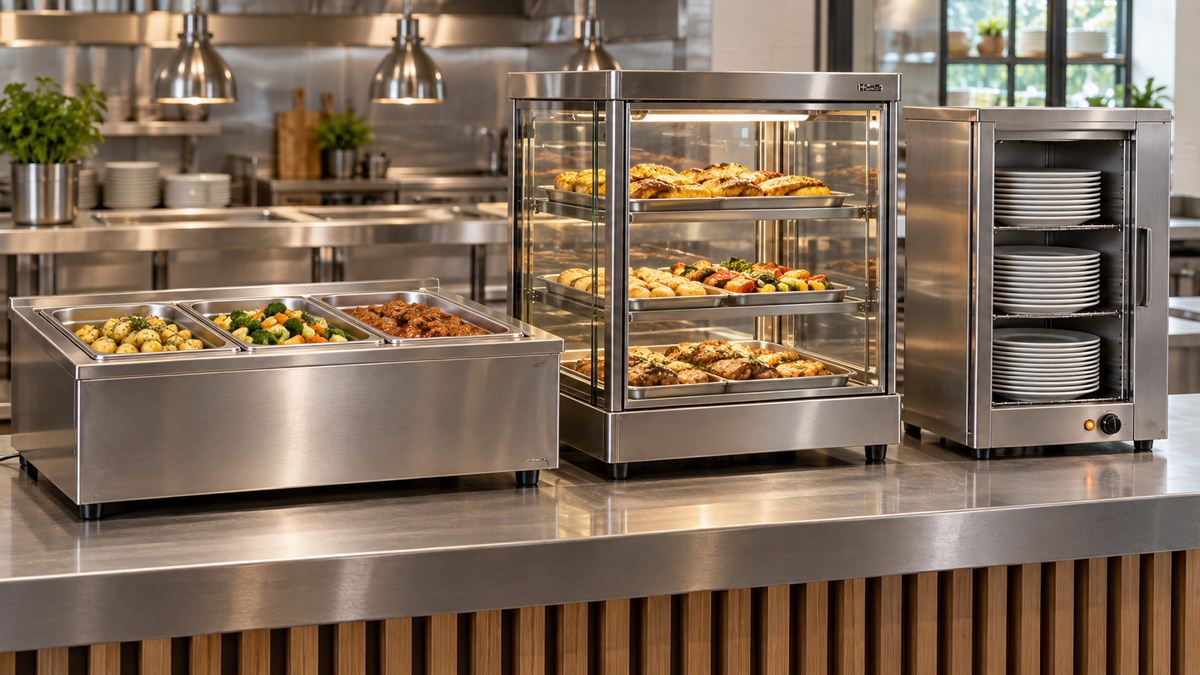
Choose a bain marie to portion hot food from pans, a heated food display to merchandise hot portions, and a plate warmer for empty, compatible plates. A venue serving pan-held food onto warm crockery may need both food holding and plate warming—not one substitute for the other.
The featured illustration shows equipment types, not verified models, dimensions or a scale layout.
Start with the serving job
The categories overlap: a glazed pan foodbar can both hold pans and merchandise food. Check the actual configuration, what goes inside and who serves—not just the category label. Treat plate warmers as equipment for empty plates unless the exact manual explicitly authorises food holding.
Some Roband bain maries permit wet or dry operation, subject to model/manual exceptions. That permission does not apply to every bain marie. A wet bath also does not establish humidity-controlled cabinet air.
Compare the same seven buying criteria
The three HC examples below are catalogue listings to discuss, not confirmed fits for your menu, load or site.
Bain marie: portion from pans
Choose this for a cafe, takeaway or buffet serving dishes from pans. Reconsider if the real job is displaying individual portions or the serving position makes pan access impractical.
What is loaded: Hot food in compatible pans. Confirm pan dimensions, depth and supports; a shared GN label alone does not establish the complete fit.
Service access: Match staff or customer reach to the guards, lids and utensils. Leave room to lift out pans without crossing the serving queue.
Moisture and texture: Assess the actual dishes and intended covers. Confirm the permitted heating mode rather than assuming wet heat suits every food.
Usable load and replenishment: Work from each dish’s usable pan fill and replacement plan, not simply the number of pan openings.
Space and clearances: Measure the bench footprint, lid or canopy access, manual-specified ventilation gaps and route for bringing replacement pans to the unit.
Water and cleaning: Where water is used, establish filling, draining and cleaning access from the manual. Do not assume fixed plumbing is required or supplied.
Power, manual and inclusions: Obtain the supplied unit’s electrical details and operating manual. Identify whether compatible pans, lids and support bars are included.
HC example: The Woodson W.BMS11 bain marie is described by HC as a compact countertop pan unit. Confirm its supplied configuration and operating mode. Browse bain maries and related pan-service equipment.
Heated food display: show hot portions
Choose this when a takeaway counter needs customers to see the hot portions available. Reconsider if the food loses its intended texture or service openings prevent suitable holding.
What is loaded: Hot portions on compatible trays or shelves. Confirm permitted packaging and keep the required air paths clear.
Service access: Decide whether staff serve from the rear or customers access the food. Door arrangement affects reach, queue separation and replenishment.
Moisture and texture: Crisp pastry and moist filled portions may need different conditions. Request a demonstration with the intended food; a humidity feature is not a quality guarantee.
Usable load and replenishment: Use actual portion spacing and shelf clearance, not exterior width or shelf count. Check that refill trays can enter during service.
Space and clearances: Allow for door travel, tray withdrawal, ventilation and staff standing room. A freestanding cabinet needs a different site layout from a benchtop unit.
Water and cleaning: Confirm whether a humidity system uses water, how it is filled and drained, and how shelves and glass are accessed for cleaning.
Power, manual and inclusions: Confirm the exact electrical supply and permitted operation from the manual. Identify included trays, shelves and any humidity-system fittings.
HC example: HC describes the Airex AXH.FDFSSQ.09 heated display with rear sliding doors and a concealed water well. Confirm the supplied controls and setup. Browse hot food displays and related equipment by their actual configuration.
Plate warmer: prepare empty crockery
Choose this for a restaurant pass needing warm plates for plating. It does not solve a food-holding requirement merely because the cabinet is warm.
What is loaded: Empty plates in materials and sizes permitted by the manual—not filled dishes by default.
Service access: Plan staff retrieval of warm stacks beside the plating area, separate from dirty returns.
Moisture and texture: The questions are plate compatibility and handling, not keeping food crisp or moist. Warming the crockery does not control food-holding temperature.
Usable load and replenishment: Check actual plate diameter, rim profile, stack height and replacement rate. A headline plate count does not establish your working load.
Space and clearances: Allow for the cabinet footprint, full door opening, stack lifting and the route from warmer to pass.
Water and cleaning: Follow the plate warmer’s own cleaning instructions. Do not infer a water tray or wet operation from generic warming-equipment copy.
Power, manual and inclusions: Confirm electrical requirements, controls, included shelves and loading instructions. Do not borrow food-holding settings from another appliance.
HC example: The Elementry PW-DE plate warmer is described by HC as a double-cabinet unit. Ask for a loading arrangement using your plates. Browse food and plate warming equipment, checking each model’s stated purpose.
Measure the food, not just the cabinet
Potentially hazardous food should normally be held at 60°C or hotter unless a validated safe alternative is in place. A cabinet-air reading or display dial does not measure the food itself: check the food with a suitable probe thermometer. See FSANZ guidance on thermometers and food temperature.
For hot holding, rapidly reheat previously cooked and cooled potentially hazardous food to at least 60°C before transfer. Do not use a bain marie or pie warmer designed only for holding as the reheater. See FSANZ cooling and reheating guidance. This is not a universal cooking setting or safe holding duration.
Worked enquiry: 36 portions and 40 empty plates
This hypothetical request separates service demand from equipment capacity. Its 30-minute window is not an approved holding period.
Our lunch counter plans to sell 36 hot portions over 30 minutes. Please compare pan service for curry with a separate shelf-display option for savoury pastries: these are alternative food/service briefs, not one interchangeable load. For each option, our provisional batch pattern is 18 portions initially plus 18 replenishment, subject to our approved food-safety and quality plan.
Please request the actual filled-pan or tray dimensions and depth, portion dimensions, weight and spacing, packaging and proposed loading layout before recommending a model. Agree a realistic serving and door-opening pattern with our team. We want our venue team and your demonstrator to assess food temperature with a probe and food quality through service, including the end of the 30-minute window, and check replenishment access.
We separately need to warm 40 empty plates for service. Please request their material, measured diameter, rim height and stack height, then confirm a practical loading and retrieval arrangement. This is a plate-warming requirement, not food holding.
Please request our site sketch showing the bench position, door and service clearances, outlet details, cleaning access and serving/refill route. Quote exact models with manuals; compatible pans, lids, support bars, trays, utensils and a suitable probe; water and draining arrangements where applicable; and any outlet work or appropriately licensed electrician needed. Include delivery, installation, commissioning, parts and service support, GST treatment, inclusions and exclusions.
Change the shortlist when the fit fails
If food temperature fails under the proposed load and access pattern, do not accept that configuration. If texture fails, reconsider the documented heat/moisture arrangement or food presentation. If usable load or access falls short, change the unit or layout, or revise replenishment within the approved food-safety and quality plan—not just the nominal capacity.
Send the enquiry, measurements and site photos through Hospitality Connect’s equipment enquiry page. Ask for a model-specific, installed quote that resolves those food, load and site questions before ordering.


