

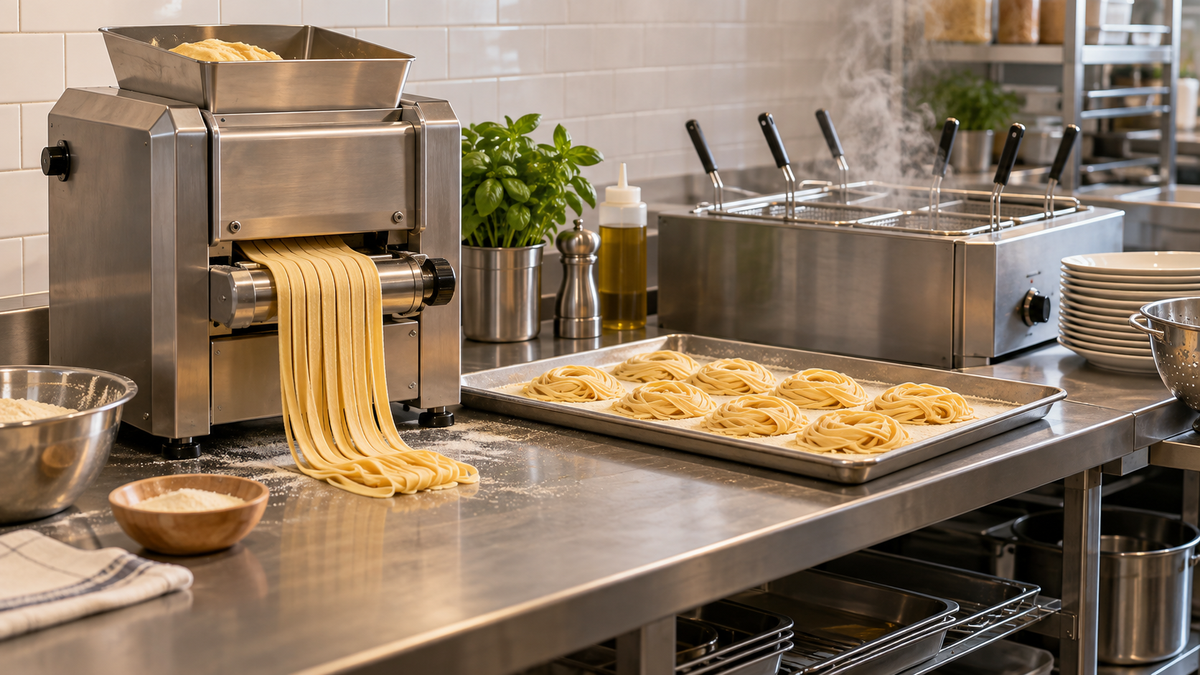
Buy only the stages your menu needs, then test the whole route. Purchased pasta may remove the need for dough-making equipment, but not storage, cooking or finishing capacity. A maker alone cannot solve a busy service: the limiting step may be tray handling, refrigeration, draining, sauce finishing or cleaning.
The featured illustration does not verify models, guarding, scale or installation.
Which route should you buy?
Bought dry or fresh pasta
Start here if the supplied product meets the menu and you cannot justify the prep labour or workspace for making it. Dry pasta still needs suitable dry storage and portion control; bought fresh pasta needs the supplier’s handling requirements and suitable storage capacity. Both need a demonstrated cooking and finishing route. Compare packs, usable portions and handling losses, not dry and fresh weights as though they were interchangeable. Cleaning remains necessary at the storage, portioning and service stations.
In-house rolled sheet and cut pasta
Allow for weighing, mixing, sheet passes, cutting, trim handling and portioning. Buy a mixer only with manufacturer confirmation for the actual pasta dough; bowl size does not prove suitability. Check roller width, thickness adjustment, cutters and guards against the menu. Filled pasta adds filling preparation and forming equipment, not just another cutter. Measure usable portions, tray space and the labour to clean the complete setup.
In-house extruded shapes
Specify the recipe, shape, compatible die and cutting arrangement together. Confirm whether the exact machine performs the required mixing stage or needs separate equipment. Demonstrate usable formed pasta after rejects and changeovers, including loading, cutting, tray handling and die cleaning. Do not substitute an extrusion rating for staffed output, storage space or service capacity.
There is no universal winner or automatic saving. Compare measured ingredient use, usable output, staff time, accessories, storage and cleanup. If those demands cannot fit the kitchen, keep the bought-pasta route rather than buying an underused maker.
What can block the workflow?
Walk the route with the operator before preparing a shopping list. Include existing equipment in the checks.
- Weigh and mix. Specify scales, containers, bench space and any manufacturer-approved mixer. Obtain the exact dough, load and permitted operating limits from the manual or manufacturer. If unsuitable: change the mixer or production route; do not infer compatibility from a general dough claim.
- Form and cut. Confirm the exact roller, cutter, extruder, dies or filling system, included parts and guarding. Request a demonstration with the chosen recipe and shape. If usable output or quality fails: resolve the attachment or process mismatch and repeat the demonstration before ordering.
- Portion, tray and store. Check usable tray positions, covers, labels, racks and any refrigeration required by the actual product and venue food-safety plan. Measure fit with loaded trays, not empty cabinet dimensions alone. If space or handling is unresolved: resolve the storage plan or reduce the planned production quantity before expanding equipment.
- Cook, drain, finish and pass. Specify the intended cooking task, compatible baskets, safe draining route, utensils, finishing pans, heat source and pass space. Test them together with the service staff. If orders queue: identify whether recovery, draining, finishing or staffing is limiting; a larger maker will not fix that stage.
- Clean and change over. Obtain component-specific instructions and time the permitted disassembly, cleaning, drying and reassembly, including tools and drying space. If it overruns the available window: simplify the shape range or consider a more suitable configuration, then retest the complete route.
How much usable pasta is required?
Hypothetical prep requirement
60 portions × 100 g of usable uncooked fresh pasta = 6 kg. With 90 minutes available, 6 kg ÷ 1.5 hours = 4 kg per elapsed hour required across that whole prep window.
The portion is a chosen example, not a serving recommendation. The window includes weighing, mixing, forming, handling, portioning, storage placement, changeover and cleaning required within it. This is demand arithmetic, not a verified machine capacity. Ingredient weight, dough load, trim, usable uncooked pasta and cooked weight are different measures; no yield or cycle count follows from the calculation.
Test the service peak separately. Suppose 18 of those 60 orders arrive within 15 minutes. Ask whether a demonstration can be arranged using the actual recipe and shapes, basket loads, repeated loading and recovery, water and starch handling, draining, sauce finishing, plating and proposed staff. Record completed dishes and queues through the pass. Basket count or tank litres alone cannot establish that this peak is achievable.
Which HC listings merit an enquiry?
Use HC’s pasta makers and accessories and noodle and pasta cooker range to assemble discussion candidates—not a pre-matched system or a stock promise.
- Sirman Sinfonia2 and Sirman Concerto5: maker-selection candidates. Request the exact Australian variant, manual, permitted recipe and compatible supplied attachments before comparing usable output.
- Sirman Raviomatic: a separate enquiry if filled pasta is required. Confirm the sheet and filling requirements and compatibility; do not assume it replaces upstream preparation.
- Apuro DG077-A pasta cooker: a cooker enquiry candidate, subject to the exact manual, intended pasta and peak-service demonstration.
- Roband MP18: Roband describes the Pasta Master’s purpose as returning pre-prepared pasta dishes to serving temperature. That is rethermalisation, not evidence of raw-pasta cooking capacity. Do not select it as a raw-pasta cooker on the listing name alone.
Can you clean and change over?
FSANZ distinguishes cleaning from sanitising: cleaning removes dirt and food residues; sanitising addresses microorganisms. Cleaning comes first. For the purchase, confirm each removable part’s permitted method, cleaning tools, drying and reassembly requirements against the exact manual. Do not assume electrical or motor units can be immersed, or that every part has the same wash method.
FSANZ’s allergen information for industry calls for managing unintended allergen presence and providing accurate information. Map ingredients, flour dust, shared tools, trays, baskets and cooking water in the venue’s allergen plan, with trained staff. Sanitising is not evidence of allergen removal. A separate basket or a gluten-free recipe does not establish gluten-free service on shared equipment or water. If controls cannot be supported, do not make that claim.
What must the installed quote cover?
- The complete working footprint: bench loading and dimensions, guarding and operating clearance, lifting and loading access, tray movement, storage, draining, waste handling, cleaning access and drying space.
- Exact Australian connections: electrical voltage, phase, current and plug or hardwired requirements; gas type and connection; water supply, backflow provisions, drainage and ventilation where applicable. Obtain exact-unit documents and a qualified installer’s site assessment—neither a countertop category nor a product photo proves installation suitability.
- The delivered system: model and part numbers, attachments, dies, baskets, smallwares, storage and cleaning equipment; current warranty, parts and service arrangements; freight, unloading, installation, commissioning and operator instruction. Identify inclusions, exclusions, GST and who supplies and connects each item.
What would you send the supplier?
This completed example uses a hypothetical bistro. It is an initial procurement enquiry, not a tested capacity or food-handling procedure.
Subject: Complete installed pasta workflow enquiry—extruded rigatoni
We are planning in-house extruded rigatoni for a tomato-sauce dish, with no filled pasta at launch. Our intended dough uses wheat and water. Please arrange to receive our exact ingredient proportions and method before recommending a model or die; do not assume a generic recipe will establish compatibility. Bought pasta remains our fallback if the complete route cannot meet the brief.
Our planning quantity is 60 portions of 100 g usable uncooked fresh pasta: 6 kg ready within a 90-minute prep window, with one prep operator. The required whole-window rate is 4 kg per elapsed hour, including mixing, forming, handling, portioning, storage placement and cleanup. This is our requirement, not a machine rating.
Our separate service test is 18 of those orders in 15 minutes, with one person cooking and draining and one finishing and plating. Please advise whether a demonstration can be arranged, any charge, and how to test the actual recipe, shape, basket loads, recovery, water/starch handling and finishing. We need timed usable output, rejects, handling and cleaning—not just an extrusion run.
Please specify the exact Australian manufacturer/model and manuals, approved recipe application, all required dies, cutters, guards, tools and compatible cooker baskets. Identify what is included and what is optional. Confirm compatibility rather than assuming that attachments or existing kitchen equipment will fit.
The proposed route runs from weighing and mixing to forming, covered labelled trays, suitable storage, cooking, draining, finishing and pass. Please provide the whole working envelope and review bench support, loading and guard access, tray/rack and refrigeration fit, waste movement, cleaning access and drying space. Storage capacity and handling arrangements need verification against our venue food-safety plan; no storage life is assumed. Include cleaning/changeover labour and component instructions, and flag allergen risks from wheat dust, tools, trays and shared cooking water.
Please supply exact electrical requirements and any applicable gas, water, backflow, drainage and ventilation requirements for qualified installer assessment. Site-service capacity is not yet verified; identify any survey or documentation needed before ordering.
Quote the complete installed system, including scales and smallwares, trays/covers/racks, required storage, forming and cooking equipment, finishing equipment, cleaning tools, delivery and unloading, installation, commissioning and operator instruction. Show GST, exclusions, lead times, warranty, spare parts and service arrangements, and who is responsible for each connection. Please identify unresolved conditions rather than pricing only the maker.
Send Hospitality Connect your pasta workflow enquiry with the menu, recipe details and site information available for assessment.
What should happen before ordering?
Resolve the limiting stage first. If the maker meets demand but storage or service fails, change that part of the system and retest. Keep items with missing manuals, uncertain attachments or unresolved services out of the final order. Compare complete installed quotes only after the proposed route, actual product and staffed peak have supporting evidence.


