

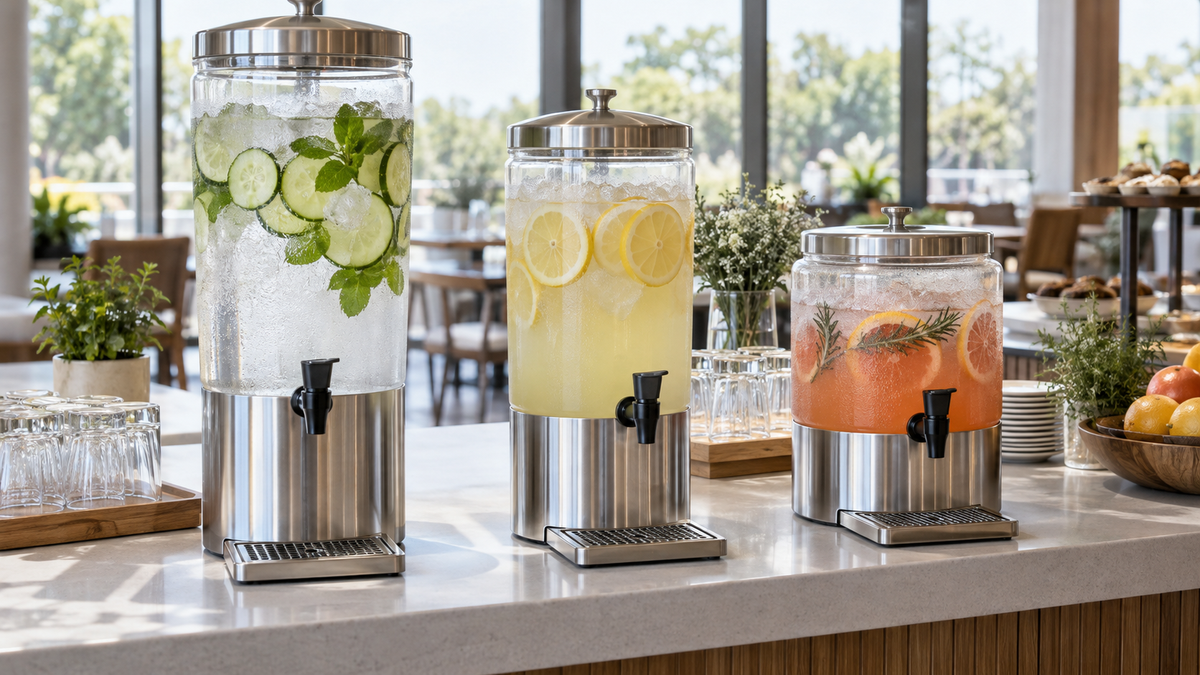
Choose a commercial drink dispenser by matching the actual drink to a proven holding method, then sizing each flavour for peak pours and the refill interval. Finally, check how staff or guests will fill cups. A large tank alone tells you neither how quickly drinks can be served nor whether they will stay at the required temperature.
Gravity-fed describes dispensing force, not cooling. A refrigerated unit may also pour by gravity. Use the Hospitality Connect drink dispenser range to shortlist formats, then compare unpowered vessels and compressor-chilled dispensers on the same criteria.
Compare the whole service task
- Drink and holding method
- Unpowered: no mechanical refrigeration; establish how the drink will be held throughout service. Compressor-chilled: active cooling, but recipe permission and loaded temperature performance still need confirmation. Neither format is a universal winner.
- Peak volume, refills and preparation
- Unpowered: plan prepared charges and accessible reserves. Compressor-chilled: do the same, and verify permitted starting temperature and recovery. Do not assume warm refills can be chilled during service.
- Serving and cup placement
- For either format, trial the actual glass or jug, drip tray, low-level flow and queue. Check whether staff can replenish without obstructing customers or exposing the drink.
- Cleaning, site and quote scope
- Both need accessible food-contact parts, filled-load support and cleaning space. Compressor equipment also needs confirmed supply and ventilation. Include trays, reserve storage, cleaning supplies and replacement parts in either quote.
For a source-labelled example, Polar’s manufacturer page for CF760-A identifies a 12 L chilled drinks dispenser and lists a 0–10°C equipment range. The nominal 12 L is not confirmed usable fill or a dispensing/chilling rate. The range does not establish that every setting, recipe, ambient condition or load will hold a potentially hazardous drink at its required temperature.
Make temperature control a buying requirement
For potentially hazardous cold drinks, FSANZ’s displaying food guidance says 5°C or colder unless a safe alternative control can be demonstrated. Not every juice or cold beverage has the same classification: confirm the actual recipe and food-safety plan. Ice or insulation alone does not establish a safe holding duration.
If using time as a control, consult the FSANZ time-control guidance. Relevant time between 5°C and 60°C is cumulative across preparation, storage, transport and display. Refilling or rechilling does not reset prior exposure. Buy equipment that supports your documented controls, rather than relying on a display setting.
Calculate each flavour, not just total litres
This is hypothetical enquiry arithmetic, not a demand forecast or machine specification. Assume 80 guests, two pours each and a 200 mL portion, without ice:
80 × 2 × 200 mL = 32 L of finished drink across the whole service. An assumed 60% orange/40% apple split requires 19.2 L orange and 12.8 L apple.
For illustration, assume a fill trial confirms 8 L usable per vessel, with one vessel per flavour. That confirmation is hypothetical here, not a named model’s rating:
- Orange: three charges — 8 L + 8 L + 3.2 L. That is the initial fill plus two replenishment actions after it.
- Apple: two charges — 8 L + 4.8 L. That is the initial fill plus one replenishment action after it.
These are planned charge quantities, not permission to top up old batches. Name the batch-exchange or refill method required by the exact manual and food-safety plan, including each batch’s holding-time tracking. Establish any ice displacement and dilution through an actual recipe and usable-fill trial.
If half the total service volume arrives in the first 20 minutes, that is 16 L in 20 minutes: customer demand, not compressor litres/hour or a machine guarantee. Peak flavour shares may differ from 60/40; verify each separately.
Match the format to the venue
- Staff-served café: an unpowered vessel may fit where staff can execute proven holding and batch controls. Consider compressor chilling where its loaded trial meets temperature and queue needs.
- Breakfast buffet: prioritise cup fit, supervised self-service, spill management and batch access. Either format must pass the holding and replenishment checks.
- Event bench: confirm cold-chain arrangements, shade and ambient exposure. Compressor equipment also needs proven power and ventilation. If neither format has demonstrated holding control for the service interval, change the location or service plan.
Seven checks before committing to a dispenser
Ask for demonstrations and record results. An unanswered check is not a pass.
- Recipe permission. Pass: the exact manual permits the drink, and a sample trial confirms pulp/tap compatibility. Document dairy and allergen handling; obtain explicit carbonation or alcohol permission where relevant. A stirrer is not permission to dispense milk. Fail or unknown: obtain manufacturer confirmation or change the recipe/unit.
- Holding performance. Pass: a representative loaded trial records beverage temperatures meeting the food-safety plan through service and replenishment. Fail or unknown: obtain a suitable trial and control evidence before selection; do not treat the display setting as proof.
- Usable fill and peak service. Pass: measured usable fill and timed tap operation/refills cover each flavour’s peak queue; record cooling recovery where relevant. Fail or unknown: revise vessel count, reserve drink supply or refill schedule, then repeat the trial.
- Cup and jug fit. Pass: the real tallest glass or jug fits beneath the tap with the tray installed, and a sample portion pours cleanly at low level. Fail or unknown: trial another compatible vessel/tap format before ordering.
- Site and handling. Pass: installers confirm supply, ventilation, lid-removal/cleaning access and bench support for the filled load; staff demonstrate suitable handling of planned loads. Fail or unknown: remeasure, reposition or quote site changes before committing.
- Cleaning and parts. Pass: food-contact taps and seals can be removed, cleaned and reassembled using the documented method; replacement parts are identified. Fail or unknown: obtain the method and parts detail or choose another unit. Never assume every component is dishwasher-safe.
- Operator routine. Pass: staff demonstrate batch labels, time/temperature records, separate allergen handling and supervised self-service response to contamination. Fail or unknown: arrange training and revise shared-handling arrangements before commissioning.
Request a complete beverage-station quote
A juicer makes juice; a dispenser serves the finished drink. If preparation equipment is also needed, use the separate juicer collection.
Send Hospitality Connect an enquiry naming each drink and its ingredients; required temperature or alternative control and evidence; service duration and peak mix per flavour; portion; confirmed usable fill and batch/refill plan; tallest cup/jug dimensions; and site, cleaning and handling constraints.
Ask for an itemised scope covering dispensers, drip trays, cups/glasses, reserve storage, cleaning supplies, spare taps/seals and training, plus freight, installation/site work and the GST basis. Confirm inclusions rather than assuming the unit price covers the whole station.


