

Updated 24 October 2026 · Hospitality Connect team.
A chafing dish holds prepared hot food for buffet service. Choose one by matching the heat source to the venue, the food pan to your replenishment plan, and the complete assembly to the serving space. A large pan alone does not tell you how many guests a chafer will serve or whether food is staying hot enough.
Plan how staff will load, monitor, serve and replace each pan at peak demand, then compare chafing dishes and chafing fuel.
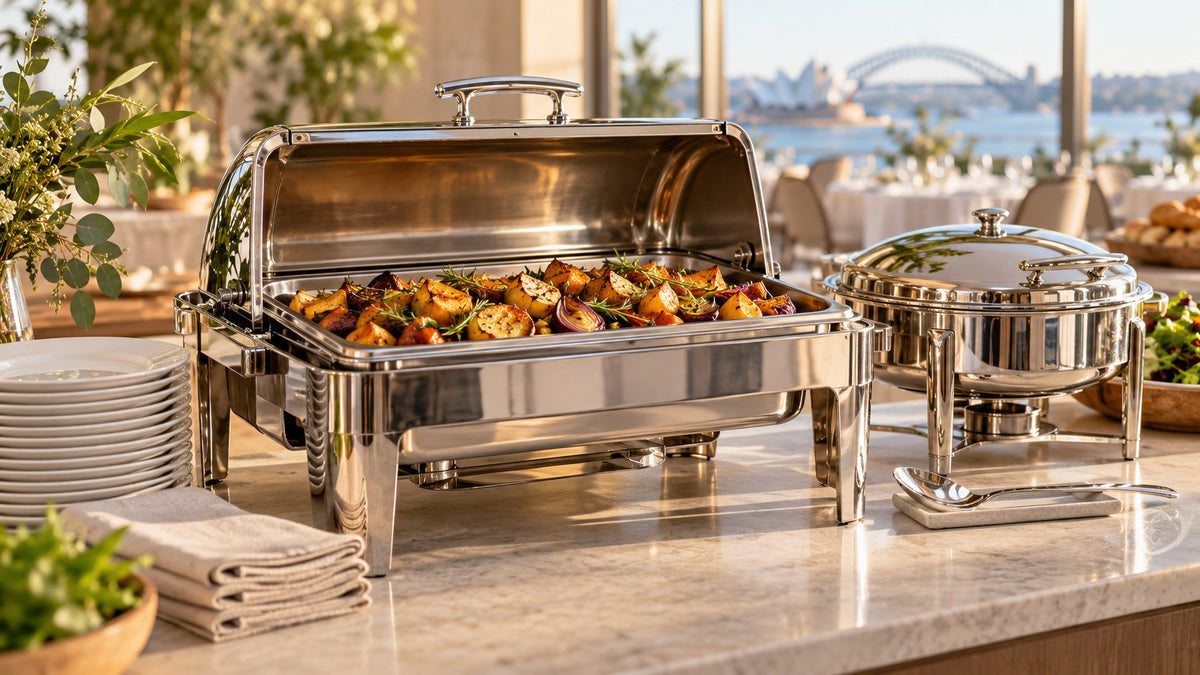
Illustrative buffet scene; check individual product specifications.
Which heat source suits your buffet?
Fuel, electric and induction systems all need food-temperature checks. Compare them against the same site, compatibility and operating requirements; a heat control or glowing indicator does not measure food temperature.
- Fuel chafing dishes
-
Site: consider when power is unavailable and the venue permits the specified fuel and open-flame equipment. Check ventilation, clearances and protection from guest contact with the venue and equipment instructions. Outdoor wind exposure also needs assessment.
Compatibility and operation: match the stand, holder and fuel to the chafer instructions. Allow staff access to inspect and extinguish the heat source. Fuel purchasing, handling and replacement form part of the service plan.
- Electric chafing dishes
-
Site: consider for a fixed serving position with suitable power. Confirm the supplied model's voltage, plug, power rating and circuit requirements; plan cables away from guest and trolley routes.
Compatibility and operation: distinguish an integrated electric chafer from a separate heater accessory. Confirm approved mounting, water use where applicable and control operation. Plan what staff will do if power or heating fails.
- Induction chafing systems
-
Site: consider where powered buffet equipment and its required clearances fit the counter layout. Include the induction appliance's ventilation and electrical requirements.
Compatibility and operation: obtain confirmation that the chafer base, induction appliance and any mounting arrangement are an approved combination. An induction label or magnetic base alone does not establish compatibility with every warmer, cooking hob or insert.
Compare complete purchase lists, including any separately supplied stand, heater, controller or fuel holder. If you are choosing between portable table service and a fixed hot-food line, our chafing dish and bain marie comparison covers that narrower decision.
How do GN size, depth and usable capacity differ?
A Gastronorm (GN) size describes the pan format. Contacto lists GN 1/1 as 530 × 325 mm; it is not the outside size of a complete chafer. Depth is another measurement, and neither GN size nor stated litres establishes a sensible working fill for every food.
A liquid dish, loosely piled vegetables and a layered pasta dish use space differently. Ask for the food pan's dimensions, depth and stated capacity, then establish a working load that leaves room for serving without spilling. Check that load through your venue's food-safety and service procedures.
- Pan fit: confirm the exact insert, rim and support arrangement. Fractional pans may need compatible divider bars; do not assume every combination is supported.
- Depth: verify clearance beneath the food pan and the permitted depth for that chafer. A deeper pan can interfere with the intended assembly.
- Complete footprint: measure the stand, handles and heater, plus lid opening, cable route, utensils and staff refill access.
- Handling: consider the loaded pan's weight and the route from kitchen to buffet, including doorways and available landing space.
Use our GN pan size and compatibility guide for dimensions, then confirm the selected Gastronorm pans against the actual chafer specification.
A demand and refill example
Suppose a hypothetical function expects 48 portions of one side dish, each 125 g: 48 × 125 g = 6 kg of planned demand. If your own service plan uses 2 kg working loads, that means three loads: one opening load and two replacement loads.
If 24 portions are expected in the busiest 15 minutes, the estimated draw is 3 kg in that period. One 2 kg opening load would therefore require replenishment before that peak ends. Arrange a monitored reserve and an accessible replacement pan rather than relying on a larger display pan alone.
These figures illustrate arithmetic only. They are not tested chafer capacity, a promise of service speed, a safe holding duration or an instruction to fill any particular pan with 2 kg.
Will the whole setup work together?
Request a written component list for the exact model: food pan, water pan where used, lid, hinge or support, stand and heat source. Confirm what is included, what is optional and which replacement parts fit. Round and shaped inserts may be model-specific rather than GN interchangeable.
Check the lid in the position guests will actually use. A lift-off lid needs a stable landing place; a roll-top or hinged lid needs its full opening envelope. Staff should be able to reach the rear pan without reaching across guests or another hot dish.
Ask how the model manages condensation and where it drains when opened. Check that drips cannot fall across the serving route, labels or electrical equipment. Position utensils with a suitable rest and provide a separate utensil for each dish. Keep dish and allergen information associated with the correct pan during replacement.
Include plates, bowls, serving utensils, signage, trays and cleaning supplies in the buffet list.
How should you set up before service?
Manufacturer instructions differ. For example, Vollrath’s induction chafer manual gives model-specific water quantities and distinguishes food-pan, water-pan and hinge cleaning. These are examples of model-specific requirements; follow the manual for your selected unit.
- Check the model instructions. Identify the approved heat source, assembly, water requirement if applicable, fill level, starting water temperature, preheat procedure and clearances. There is no universal water quantity or preheat time for all chafers.
- Inspect and position. Check stability, pans, handles, hinges, glass, fuel fittings or electrical leads as applicable. Remove damaged equipment from use and arrange repair or replacement. Confirm venue permission and the final guest/staff route.
- Assemble and preheat as directed. Use the specified components and operating method. Do not improvise a fuel-to-electric conversion or run a water-bath model dry.
- Load prepared hot food. Transfer food under your food-safety procedure, check its temperature and record the opening check. A conventional buffet chafer should not be treated as a cooker or a way to slowly reheat cold food.
- Assign checks and replacement duties. Have the food thermometer, records, clean utensils and replacement pans ready before guests arrive.
How do you keep food under temperature control?
Food Standards Australia New Zealand (FSANZ) requires potentially hazardous food to be held at 60°C or hotter for hot holding, unless the business can demonstrate a safe alternative system. That means the food temperature: a lit burner or heater setting does not prove compliance. Use your venue’s food-safety procedure, including any stricter requirements that apply to your operation.
Use a clean, sanitised probe thermometer suitable for the food, checking representative food locations under your venue's procedure. Measure the food itself; water temperature, appliance settings and an infrared surface reading do not establish the temperature throughout a pan.
- Before opening and during service: record food temperature and check heat supply, water level where applicable and serving condition. Set monitoring intervals in your food-safety procedure to suit the actual operation; check again after loading or a fault.
- If food falls below the required holding temperature: stop serving that pan, isolate it and establish its time-temperature history. Follow your corrective-action procedure; raising the heat control and continuing service is not a sufficient response.
- If heat or water supply fails: stop using the affected equipment, protect guests from hot surfaces and spills, and assess the food separately. Restore equipment only by its instructions and recheck food before service resumes.
- When replenishing: replace with a separately controlled pan and record its identity/time as required. Avoid mixing new food into an older batch, which obscures its history.
For potentially hazardous food taken out of refrigeration, the FSANZ 2-hour/4-hour rule counts cumulative time between 5°C and 60°C: under two hours, use or refrigerate; two to less than four hours, use without re-refrigerating; four hours or more, discard. Include earlier preparation, transport and display exposure. This is not a four-hour allowance for an unknown history or a holding limit for food verified at 60°C or hotter. If the history cannot be established, do not serve the food; follow your corrective-action procedure.
For previously cooked and cooled potentially hazardous food intended for hot holding, FSANZ requires rapid reheating to at least 60°C, ideally within two hours. Use suitable reheating equipment and your documented procedure before transferring to the holding setup. A chafer designed only for holding is unsuitable for slowly reheating food.
How should you clean and store a chafer?
Shut down using the equipment and fuel instructions. Disconnect electrical equipment where directed, extinguish fuel by its prescribed method and let components cool before dismantling or draining. Do not move a lit or hot assembly through the guest area.
Separate removable food-contact parts from the stand, heater, controls and lid mechanism. Clean and sanitise food-contact parts under your venue procedure using methods suitable for the component. Follow the manufacturer's detergent, abrasive and dishwasher restrictions; stainless steel construction does not make the entire assembly dishwasher-safe.
Keep electrical bases and controls out of water unless their instructions expressly permit otherwise. Check hinges, glass, seals and moving parts separately. Dry components before storage and protect them from impact. Stack only where the product design allows it, and keep matched accessories identified for the next service.
What should you send with a supplier enquiry?
Send Hospitality Connect's team the following checklist with the model or product link you are considering:
- Menu items, estimated portions, peak demand and intended replacement-pan loads.
- Available counter dimensions, lid clearance, staff access and transport route.
- Permitted heat source, power details and any venue restrictions.
- Required pan format, depth, working volume and complete component list.
- Manuals, approved accessories, cleaning requirements and replacement-part details needed before purchase.
If a dimension, component or approval is unconfirmed, resolve it before ordering. Explore the buffet and serving range to assemble the holding, serving and table-service items around the same workflow.
Food-safety sources checked in October 2026; apply your venue's current procedures and the exact equipment instructions.


