

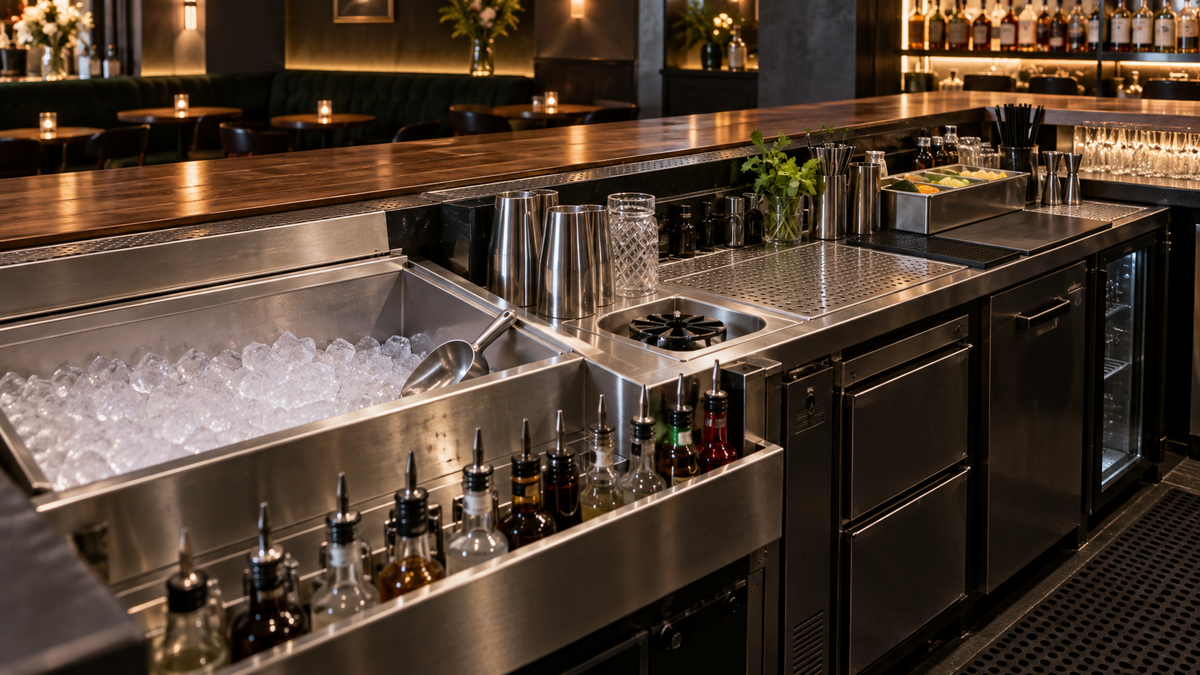
Plan a cocktail bar fit-out around the route from clean glass to finished drink, with a separate return route for dirty glassware. Put the ice well, bottle rail and mixing space where they serve that route, then resolve water, drainage, refrigeration and cleaning access before ordering modules. An attractive stainless station is only one part of the purchase.
Use the work-zone plan and order checks below to assemble a compatible bar section. The Hospitality Connect cocktail and bar module range is the shopping destination; this guide helps you decide what the layout and quote need to include.
How should you map the work zones before choosing equipment?
Draw the available run to scale, including pillars, door swings, existing services and the route into the bar. Mark where staff receive orders, build drinks, hand them over, return glasses and replenish supplies. Test the plan with the people who will work there using your actual menu and glassware.
| Zone | What belongs there and what to test |
|---|---|
| Order and handover | Order display or docket, service mat and space for completed drinks. Check that waiting orders do not occupy the mixing area. |
| Clean glass and mixing | Clean glasses, shaker tins, jiggers, strainers and garnish containers. Build a representative order without reaching through dirty returns. |
| Ice and frequent bottles | Ice well, scoop storage and a rail for the bottles used most often. Test reaching and refilling with the actual bottle sizes. |
| Dirty return and washing | Return surface, suitable glass racks, waste and the washing process. Trace the dirty route without putting used glasses above exposed service ice. |
| Replenishment and storage | Backup bottles, cold ingredients, spare tools and cleaning supplies. Check doors and drawers while another person uses the station. |
A useful mock-up is a taped bench outline with boxes representing modules and your own tools. Run a mixed order, a glass return and an ice refill at the same time. Record each collision or blocked reach; move the item or revise the module plan and repeat. This is a layout trial, not proof of a particular drinks-per-hour capacity.
There is no universal module width or aisle dimension in this guide. Have the designer and relevant trades assess the particular premises, access and applicable requirements. Keep the agreed drawing with the supplier quote so everyone works from the same version.
Integrated cocktail station or separate ice well: which suits the job?
An integrated station is a starting point when you are planning the whole bar run. A separate ice well is worth investigating when the existing bench remains and only its ice provision needs changing. Compare the complete installed arrangement, including the work surface and services, rather than the appliance photograph alone.
- Integrated module: confirm the usable mixing area, ice compartment, rail and any rinser supplied. The title “cocktail station” does not establish every inclusion or the position of each outlet.
- Drop-in well: obtain the exact cut-out, flange and support drawing before modifying an existing bench. Check the space below for insulation, waste fittings and service access.
- Weld-in well: agree the fabrication and finishing work with the bench fabricator. Do not treat a weld-in listing as a drop-in replacement with the same cut-out.
The current HC catalogue lists a Simply Stainless 700 Series cocktail station with speed rack and large ice well, and a 3Monkeez ICE-303020 insulated weld-in ice well. These show two purchasing paths in the checked range, not an interchangeability claim.
Use the commercial ice well range to shortlist the format. Ask for the exact model drawing, internal usable capacity, insulation details, lid and scoop provision, outlet location, delivery dimensions and installation instructions. Confirm the supplied configuration and availability in writing.
How much ice storage and production do you need?
An ice well holds service ice; it does not make it. The ice machine's production, its storage bin, the service well and the refill route are separate decisions. Check consumption over the busiest service window, including ice used for shaking, serving and other station tasks.
- Measure a representative service: record the kilograms removed for drinks and other uses over a defined period, with the actual ice type and menu.
- Choose a refill interval: identify who can replenish the well and the route they use during the rush. Test that the route does not cross dirty glass returns.
- Compare usable storage: request the supplier's usable ice capacity for the proposed well. External dimensions or bowl litres alone do not establish kilograms of your ice.
- Check supply separately: obtain the ice machine's production data under relevant water and ambient conditions, its bin capacity and the venue's whole-day demand.
Illustrative planning example: 40 drinks in 20 minutes at an assumed 0.20 kg of serving ice per drink consume 8 kg. Adding a separate assumed 2 kg for shaking and other use makes 10 kg for that interval. Those inputs must be replaced by your measured usage; melting, different recipes and a longer refill interval can change the requirement. This is not a rating for the models linked above.
If the well's usable capacity or refill access cannot support the interval, revise the well size, replenishment arrangement or station count before ordering. Keep usable service storage separate from a manufacturer's daily ice-production figure.
What does a glass rinser do, and what still needs washing?
A glass rinser provides a water rinse at the station. A rinse alone does not demonstrate that glassware has been cleaned and sanitised for reuse. Plan the appropriate washing and sanitising process, dirty-glass landing space and clean-glass storage separately.
Food Standards Australia New Zealand's cleaning and sanitising guidance distinguishes removing dirt and food residue from destroying microorganisms, and says items need cleaning before sanitising. Follow the equipment and chemical manufacturers' documented procedures rather than using a brief rinse as a substitute.
The checked 3Monkeez R-KGR-100 listing describes a sink-mounted rinser with a push-down actuator and round drain tray. For that or another option in the jug and glass rinser range, confirm the actual water supply, required pressure, connection, mounting and waste arrangement from the current installation sheet.
Have the plumber assess the complete installation, including any applicable backflow and approval requirements. Do not infer site approval from a generic product description or assume all rinsers have the same certification. A rinser is also not a replacement for the required handwashing arrangement.
How do you choose speed rails without obstructing the bar?
Start with the frequently used bottles, including their actual diameter, height and pourers. Arrange them on a mock rail and test selection, replacement and cleaning while another person opens the equipment below. Less-used bottles can have a separate storage location.
HC's Simply Stainless five-bottle speed rack listing gives a nominal bottle count. It does not prove that five of your particular bottles fit, or that the rail can mount to your chosen station. Ask for the rail's usable dimensions, compatible mounting, fasteners and cleaning/removal instructions.
Check that the installed rail does not block knees, fridge doors, drawers, controls or waste access. Resolve a conflict by changing its position or format and retesting. Bottle count is a selection aid, not a universal capacity or an installation drawing.
What belongs in the complete bar purchasing list?
Combine the stainless modules with the rest of the service system. Give each line an exact model or compatible format, quantity, inclusion status and unresolved question. The HC bar equipment and accessories range can help assemble the smaller service items around the larger station.
- Working tools: match shaker tins, jiggers, strainers, spoons and cutting tools to the menu. Provide duplicates where your measured workflow needs them, without imposing a universal kit count.
- Glassware and racks: trial the tallest and widest glasses in the intended rack and machine. Confirm clean storage and enough working stock for the observed washing cycle.
- Ingredients and cold storage: allocate covered garnish containers, compatible lids and refrigeration appropriate to the ingredients. An unpowered garnish holder does not establish temperature control.
- Ice handling: include suitable scoops, a clean storage place and the refill equipment. Separate ice intended for drinks from a dirty return or waste position.
- Cleaning and waste: allocate documented cleaning products, their separate storage, removable components and access to drains. Follow chemical labels and equipment instructions.
- Services and delivery: include plumbing, electrical work where applicable, fabrication, freight, unloading and commissioning in the written scope. Identify what is excluded and whether quote amounts include GST.
Checks before ordering and on delivery
- Layout: pass when a mixed order, dirty return and refill can be walked through without blocked working positions. If they clash, revise the drawing and repeat the mock-up.
- Exact inclusions: pass when the quote identifies every module, well, rail, rinser and accessory by model or agreed specification. Resolve missing or inconsistent listing details with the supplier before ordering.
- Services: pass when the relevant trades have the model drawings and have confirmed the site scope, connections and required checks. Keep uncertain water, waste or power requirements open until resolved.
- Capacity: pass when measured ice demand, usable storage and a tested refill route support the chosen interval. Mark untested output as unknown and obtain the missing data.
- Cleaning access: pass when the proposed arrangement permits the manufacturer's cleaning and maintenance procedure, with reachable components. Change the layout if a drain or removable part becomes inaccessible.
- On delivery — receiving: match the delivered model, components and documents to the quote before cutting a bench or connecting services. Photograph discrepancies and contact the supplier for resolution.
Common cocktail bar fit-out questions
Can a larger ice well fix an undersized ice machine?
It can change service storage, but cannot increase ice production. Compare production, storage and replenishment separately using your actual demand.
Should every bartender have a separate rinser?
Base that decision on the layout trial and workload. A shared unit may suit one arrangement but create crossing and queues in another; no universal staffing ratio is assumed here.
Can I compare stations by overall width alone?
No. Compare usable mixing area, ice storage, inclusions, services and access with the same menu and working arrangement. Two equally wide stations can allocate that space differently.
Send HC your scaled drawing, menu, measured peak ice use, bottle and glass sizes, existing services and delivery access. Request a marked-up module quote and a list of unresolved site requirements. Ask Hospitality Connect about your complete bar section.
HC catalogue and FSANZ guidance checked 14 October 2026. The ice calculation is hypothetical and the reused image is illustrative. This guide does not certify a site, guarantee stock or claim measured equipment performance.


