

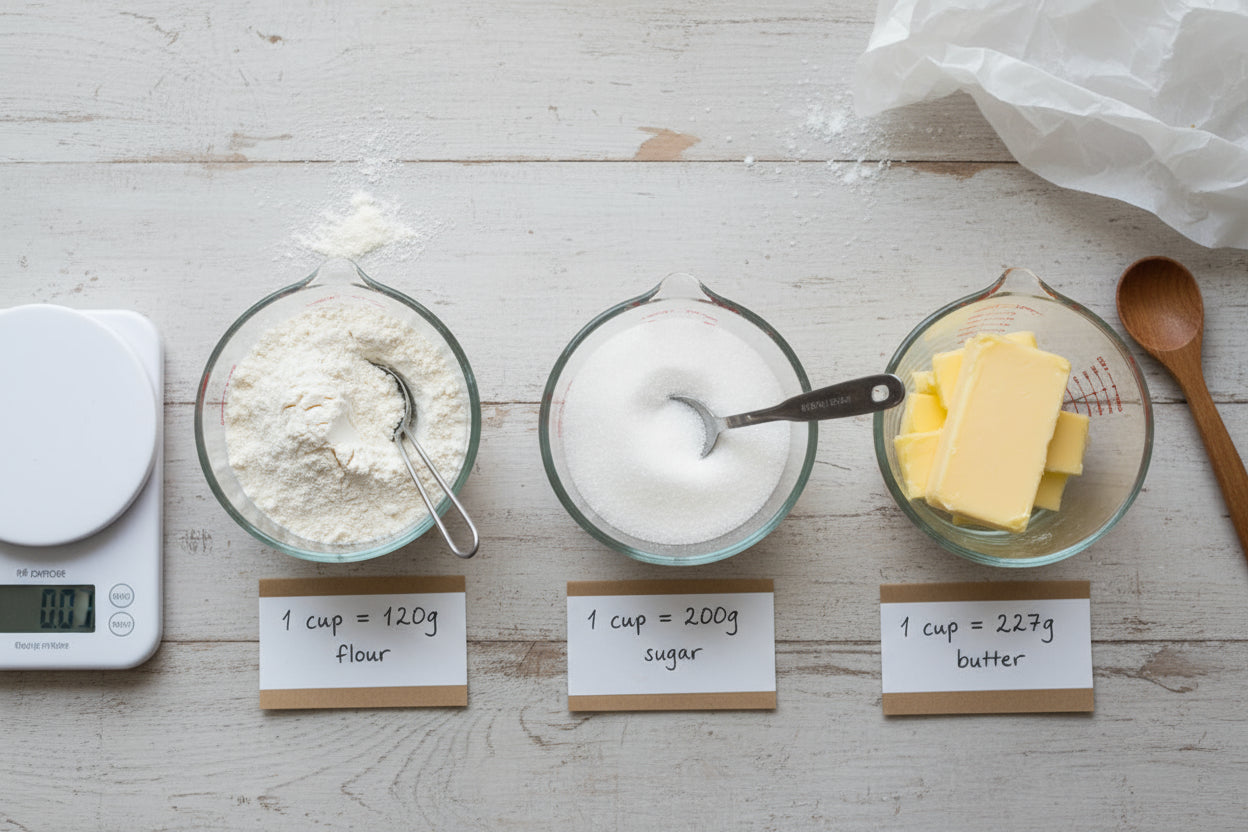
Converting cups to grams accurately is essential for professional kitchens where precision means consistency and consistency means happy customers. Whether you're baking pastries, prepping sauces, or scaling up recipes, understanding ingredient densities can make or break a dish.
This comprehensive guide covers Australian metric cup conversions, ingredient-specific charts for flour, sugar, butter and more, plus the professional measuring tools that ensure accuracy every time.
Why Accurate Measurements Matter in Professional Kitchens
Every chef knows that a tablespoon too much or too little can ruin a recipe. In commercial settings, measurement accuracy directly impacts food cost, waste management, and customer satisfaction.
For example, 1 cup of flour may weigh anywhere from 110 g to 130 g depending on humidity, sifting method, and how tightly it's packed. Using calibrated measuring jugs and digital scales ensures precision and reproducibility across every shift.
Weight-based measurements also simplify recipe scaling for batch cooking, catering events, and menu development.
Australian Metric Cup Standard: Quick Reference
Before diving into ingredient-specific conversions, it's important to understand the Australian metric cup standard, which differs from US and UK measurements.
| Cup Measurement | Millilitres (ml) | Grams (Water) | Grams (Flour) | Grams (Sugar) |
|---|---|---|---|---|
| ¼ cup | 60 ml | 60 g | 30 g | 50 g |
| ⅓ cup | 80 ml | 80 g | 40 g | 67 g |
| ½ cup | 125 ml | 125 g | 60 g | 100 g |
| 1 cup | 250 ml | 250 g | 120 g | 200 g |
| 2 cups | 500 ml | 500 g | 240 g | 400 g |
Note: 1 Australian metric cup = 250 ml, compared to 240 ml (US) and 284 ml (UK). Always verify which standard your recipe follows.
Flour Conversion Chart: All-Purpose and Beyond
Flour weight varies significantly by type, aeration, and measurement method. For maximum accuracy, spoon flour into your cup and level it off with a straight edge rather than scooping directly from the bag.
| Cup Measurement | Millilitres (ml) | Grams (All-Purpose Flour) |
|---|---|---|
| ¼ cup | 62.5 ml | 30 g |
| ⅓ cup | 83 ml | 40 g |
| ½ cup | 125 ml | 60 g |
| 1 cup | 250 ml | 120 g |
| 2 cups | 500 ml | 240 g |
Sugar Conversion Chart: White, Brown, and Icing
Different sugars have different densities. Brown sugar packs more tightly than white granulated sugar, while icing sugar (powdered sugar) weighs considerably less due to air content and fine particle size.
| Cup Measurement | Granulated Sugar (g) | Brown Sugar (g) | Icing Sugar (g) |
|---|---|---|---|
| ¼ cup | 50 g | 55 g | 40 g |
| ⅓ cup | 67 g | 75 g | 55 g |
| ½ cup | 100 g | 110 g | 80 g |
| 1 cup | 200 g | 220 g | 160 g |
For small-batch desserts or precision spice measurements, consider using a mini measuring glass to avoid waste and improve consistency.
Butter Conversion Chart
Butter conversions are more consistent because butter has a relatively uniform density. For best accuracy, measure butter at room temperature and use a flat-edged tool to level off cup measurements.
| Cup Measurement | Grams (Butter) |
|---|---|
| ¼ cup | 57 g |
| ⅓ cup | 76 g |
| ½ cup | 113 g |
| 1 cup | 227 g |
| 2 cups | 454 g |
When melting butter or portioning oils, a 600 ml measuring jug with clear graduated markings is ideal for precise liquid measurements.
Additional Ingredient Conversions for Commercial Kitchens
Below are more common ingredients used across cafés, bakeries, and commercial kitchens. These conversions assume standard room temperature and proper measuring technique.
| Ingredient | 1 Cup (Approx. g) | Notes |
|---|---|---|
| Rice (uncooked) | 195 g | Rinse before weighing |
| Oats (rolled) | 90 g | Lightly packed |
| Honey | 340 g | Thick consistency - weigh directly |
| Milk | 250 g | 1:1 ml = g |
| Oil (vegetable) | 225 g | Use liquid measuring jug |
| Cocoa Powder | 100 g | Sift before measuring |
Professional Measuring Tools for Precision
Equipping your kitchen with Australian-standard measuring tools is critical for recipe accuracy, compliance, and staff training. Investing in durable, calibrated equipment reduces error and improves workflow efficiency.
Professional-grade utensils and gadgets should be dishwasher-safe, clearly marked, and suitable for high-volume use. Consider stocking multiple sets for different prep stations to avoid cross-contamination.
Recommended Measuring Equipment
- Measuring jugs: Choose heat-resistant glass or BPA-free plastic with clear metric graduations
- Digital scales: Look for models with tare function, gram and ounce display, and at least 5 kg capacity
- Measuring cups and spoons: Stainless steel sets are more durable than plastic for commercial use
- Graduated cylinders: Ideal for small-volume liquids in cocktail or coffee service
Expert Tips for Accurate Ingredient Conversions
Consistency in measurement technique is just as important as the tools you use. Train all kitchen staff on these best practices to maintain quality across shifts and reduce food waste.
Key Takeaways
- Always weigh dry ingredients rather than scooping — it eliminates compaction variables
- Calibrate your digital scale weekly using a certified test weight
- Use Australian-standard measuring tools to ensure recipe compatibility
- Spoon flour into cups and level with a straight edge — never scoop directly
- Keep a laminated conversion chart at each prep station for quick reference
- Store separate measuring jugs for different liquid types to avoid flavour transfer
Technique Checklist
- Weigh, don't scoop: Scooping flour compresses it and can add 15–20% extra weight
- Zero your scale: Always use the tare function after placing your container
- Check temperature: Measure butter and other fats at room temperature unless specified otherwise
- Sift when required: Cocoa powder, icing sugar, and some flours require sifting before measuring
- Read at eye level: For liquid measurements, place jug on a flat surface and read the meniscus at eye level
Frequently Asked Questions
How many grams are in 1 cup?
It depends entirely on the ingredient. For example, 1 cup of water equals 250 g, 1 cup of all-purpose flour equals 120 g, and 1 cup of granulated sugar equals 200 g. Always refer to ingredient-specific conversion charts.
Is 1 cup equal to 100 grams?
No. Cups measure volume while grams measure weight. The gram equivalent of 1 cup varies based on the ingredient's density. Water is close to 1:1 (250 ml = 250 g), but most dry ingredients differ significantly.
What is the Australian standard cup size?
One Australian metric cup equals 250 ml. This differs from the US cup (240 ml) and UK cup (284 ml). Always confirm which measurement standard your recipe uses, especially when sourcing recipes internationally.
What is the best way to convert cups to grams?
Use a digital kitchen scale that switches between metric and imperial units. For liquid conversions, a graduated measuring jug with clear millilitre markings provides accuracy. Keep a printed conversion chart laminated near your stainless steel work bench for quick reference.
Where can I find professional measuring tools in Australia?
Look for Australian-standard certified measuring equipment designed for commercial use. Quality suppliers stock heat-resistant jugs, stainless steel measuring sets, and calibrated digital scales suitable for high-volume kitchens.
Conclusion: Build Your Reputation on Precision
From small cafés and coffee shops to large-scale commercial kitchens, mastering cups to grams conversions ensures every dish meets the highest standards of taste, presentation, and profitability.
By following this guide and equipping your kitchen with professional-grade measuring tools, you'll reduce waste, improve consistency, and build customer trust through repeatable quality.
Ready to upgrade your measuring equipment? Explore the full range of Australian-standard measuring cups, jugs, and utensils — trusted by hospitality professionals across Australia.


