

In today's fast-paced food industry, food delivery platforms like Uber Eats have shifted from a "nice-to-have" to an essential tool for restaurants, cafés, and takeaways. But while the potential to reach more customers is undeniable, the costs can be steep.
Is Uber Eats right for your business?
This guide breaks down the benefits, operational realities, and disadvantages of using Uber Eats. We'll also explore how partnering with delivery platforms can serve as a powerful marketing exercise for your hospitality brand.
Benefits of Using Uber Eats for Your Restaurant

Immediate Visibility and Customer Reach
Uber Eats exposes your business to thousands of active users searching for food right now. Appearing on the platform puts you in front of a "hyper-local" audience who may never have walked past your physical storefront.
It taps into the convenience economy — customers who want your food but aren't willing to travel for it. This visibility is particularly valuable for newer venues building brand awareness in their local area.
Convenience Wins Sales
Consumers prioritise convenience above almost everything else. Delivery apps reduce the friction of buying; customers can browse, order, and pay in seconds.
If you aren't offering delivery, you're voluntarily handing market share to competitors who are. In Australian metropolitan areas, delivery availability has become a baseline customer expectation.
Boost Sales During Quiet Periods
If your dine-in traffic is inconsistent — for example, quiet Tuesdays or rainy nights — Uber Eats can fill the gaps. It provides incremental revenue that helps cover fixed costs like rent and labour, which you pay regardless of how many tables are full.
Many successful operators use delivery platforms specifically to maximise kitchen utilisation during off-peak hours, improving overall profitability.
Easy Setup and Logistics
Building your own delivery fleet is expensive and brings insurance complications. Uber Eats handles the logistics, driver tracking, and payment processing.
This allows you to focus on cooking and food preparation rather than managing drivers, route planning, or vehicle maintenance.
Data and Customer Insights
The platform provides analytics on ordering behaviour. You can see which dishes are popular, where your customers are located, and what your peak times are.
This data helps you optimise your menu engineering strategy, adjust prep schedules, and make informed decisions about which dishes to promote or remove.
Things to Consider Before Joining Uber Eats

The Commission Cost
This is the biggest hurdle. Uber Eats typically takes a commission of between 30% to 35% for delivery orders. You must factor this into your pricing strategy.
Many venues offer a "delivery menu" with slightly higher prices to protect their profit margins. This isn't dishonest — it reflects the true cost of providing delivery service through a third-party platform.
Menu Engineering is Critical
Not every dish travels well. Steaks can go cold; fries can get soggy. Your delivery menu should be strategically designed for travel and reheating.
Audit your menu: Remove items that degrade quickly or arrive poorly. Focus on dishes that hold their quality for 20–30 minutes after leaving the kitchen.
Modify items: Swap thin fries for wedges (which hold heat better), put sauce on the side, or choose sturdier salad ingredients. Consider how items will look when the customer opens the container.
Simplify: Offer a reduced menu to keep commercial kitchen operations smooth and maintain quality control during busy periods.
Operational Workflow Challenges
A delivery tablet pinging during a Friday night rush can break a kitchen if you're not prepared. You must ensure orders are prepared on time — drivers hate waiting and late orders damage your ratings.
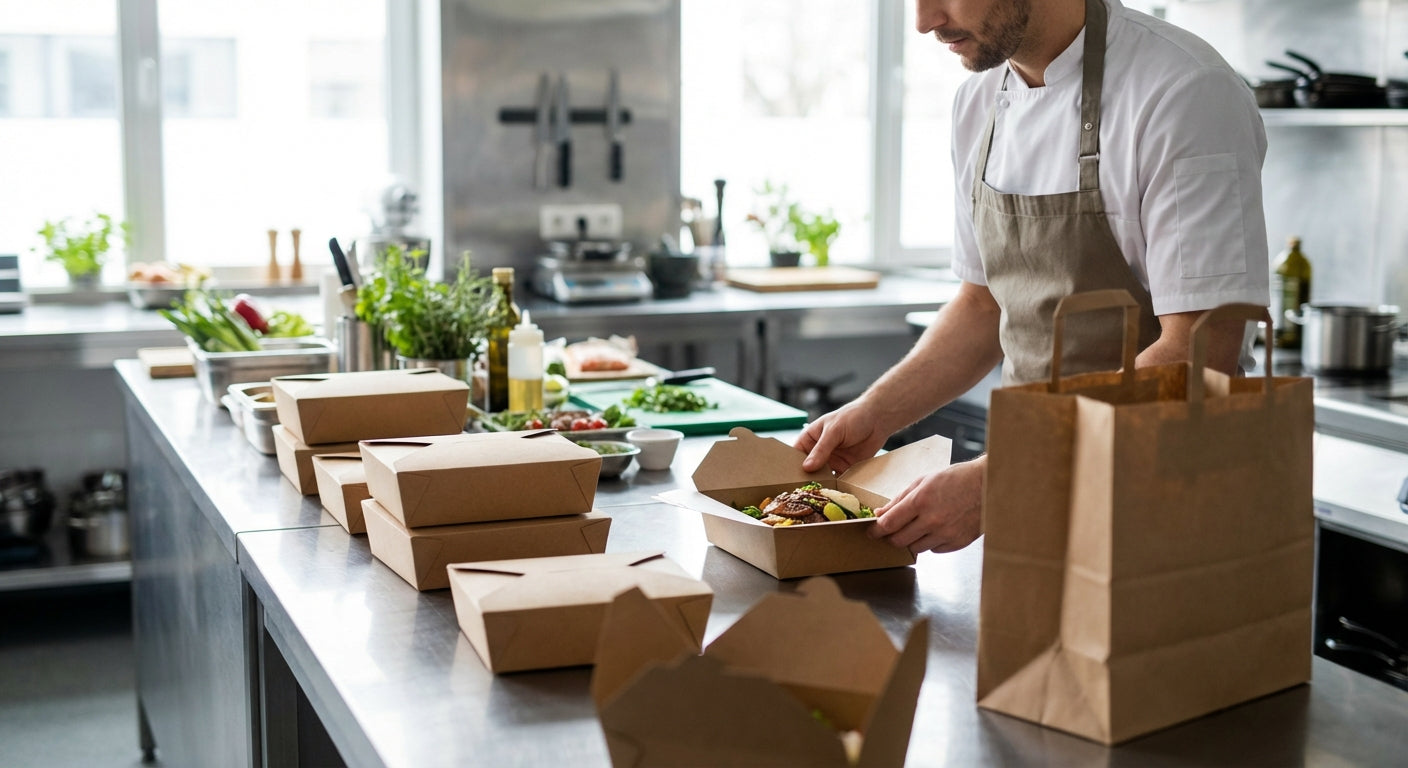
Make sure packaging and storage containers are stocked and accessible. Staff should have a dedicated station for packing delivery orders so it doesn't interfere with dine-in service. Suppliers like Castaway and Biopak offer a wide range of takeaway-ready containers suited to Australian hospitality operations — from standard clamshells through to compostable and eco-friendly options.
Consider investing in a food warmer or holding cabinet specifically for delivery orders during peak times to maintain quality while waiting for driver pickup. Brands like Woodson and Roband manufacture benchtop holding solutions designed for exactly this purpose — keeping plated meals at temperature without continuing to cook them.
Brand Control and Customer Experience
Once the bag leaves your counter, the experience is out of your hands. If a driver handles the order poorly or arrives late, the customer often blames the restaurant, not the driver.
Tip: Use tamper-evident stickers and high-quality branded packaging to reassure the customer that the food left your kitchen in perfect condition. This small investment protects your reputation.
Disadvantages of Using Uber Eats

Reduced Profit Margins
If you don't adjust your pricing, the commission fees will consume your profits. You cannot sell food on Uber Eats at the same price as dine-in and expect the same bottom line.
Factor in packaging costs as well — quality containers, bags, and utensils add up. Your delivery menu pricing needs to account for commission, packaging, and the additional kitchen labour required.
Loss of Customer Relationship
You don't own the customer data. You don't get their email address for your newsletter, and you can't upsell them a dessert or drink at the table.
You are strictly a food provider, not a host. This makes building customer loyalty more challenging compared to dine-in experiences where you can create memorable service moments.
High Competition on the Platform
You'll be listed alongside dozens of direct competitors. To stand out, you need professional food photography, a high rating (4.5 stars or above), and compelling menu descriptions.
The platform's search algorithm favours highly-rated venues with fast preparation times, so inconsistency can quickly push you down the rankings.
How Uber Eats Becomes a Marketing Exercise

Don't just view Uber Eats as a sales channel — view it as a paid customer acquisition strategy that extends your marketing reach.
The "Digital Billboard" Effect
The platform places your brand in front of local customers who may not know you exist. Many people discover a restaurant on Uber Eats, enjoy the food, and decide to visit in person for the full experience later.
This is effectively "paid sampling" that introduces your menu to new customers. The commission you pay doubles as a customer acquisition cost that can lead to repeat dine-in business.
Social Proof Through Ratings
High ratings on Uber Eats act as trust signals that extend beyond the platform. A strong digital reputation often translates to higher foot traffic and better visibility in Google Business Profile local search results.
Positive reviews create a virtuous cycle: better ratings lead to more orders, which generate more reviews, further improving your visibility.
Professional Food Photography as a Hook
Investment in high-quality food photography for the app is essential. These images are your "shop window" and the first impression for potential customers.
Delicious-looking photos capture attention and dramatically improve conversion rates. These images can also be reused on your Instagram, website, and printed menus, maximising your return on the photography investment.
Built-In Promotional Tools
Uber Eats offers marketing levers you can activate, such as:
- "Buy 1, Get 1 Free" promotions: Great for moving excess stock or introducing new menu items
- $0 Delivery Fee deals: Increases conversion rates, particularly for new customers
- Featured Placement: Boosts visibility during traditionally quiet periods
- First-order discounts: Helps convert browsers into buyers
These tools give you control over your marketing spend and allow you to test different offers to see what resonates with your local market.
Algorithm-Based Retargeting
Once a customer orders from you, the app's algorithm is more likely to show them your venue again. You're paying for the first acquisition, but the second and third orders become progressively easier to secure.
This built-in retargeting effect means your effective customer acquisition cost decreases over time as you build a base of repeat delivery customers.
Frequently Asked Questions
Is Uber Eats worth it for small businesses?
Yes — provided you price your menu correctly and maintain quality control. If you treat it as a marketing channel that brings in extra volume during quiet periods, it can be highly effective.
If you rely on it as your only source of income without adjusting prices, the margins will be too tight to sustain profitability.
Can I set my own delivery prices?
Uber Eats sets the delivery fee the customer pays to the driver. However, you have full control over your menu prices.
Most venues mark up their delivery menu by 20–30% compared to dine-in prices to offset commissions and packaging costs. Customers generally understand and accept this difference.
Do customers prefer ordering directly from restaurants?
Many loyal customers prefer ordering directly to support local business and avoid platform fees. However, the mass market prefers the convenience of an app that stores their address, payment details, and order history.
Offering both options — your own ordering system and platform presence — is the best strategy to capture all customer segments.
What if I can't handle high order volume?
Uber Eats allows you to "pause" orders or switch to "busy mode," which extends preparation times shown to customers. This prevents your kitchen from being overwhelmed during peak service.
You can also adjust your operating hours on the platform to only accept delivery orders during times when your kitchen has capacity.
Can Uber Eats help me attract new customers?
Absolutely. It's one of the fastest ways to get your food in front of customers who live within your delivery radius but haven't visited you yet.
The platform's search and recommendation features actively introduce your venue to relevant audiences based on cuisine type, location, and ordering patterns.
What commission does Uber Eats charge Australian restaurants?
Uber Eats typically charges a commission of between 30% and 35% on delivery orders. This is the single biggest cost to model before signing up. Factor it into every item on your delivery menu to ensure you're still generating a viable margin after commission and packaging costs are accounted for.
Making Uber Eats Work for Your Business
Using Uber Eats is a trade-off: you sacrifice margin for volume and visibility. When implemented strategically, it can be a powerful way to grow your business and keep your kitchen busy during traditionally quiet periods.
Success requires a strategic approach — specifically regarding menu pricing, packaging quality, and kitchen workflow integration. Your commercial kitchen setup should support efficient delivery order preparation without compromising dine-in service.
Treat delivery platforms not just as a sales channel, but as a marketing engine that pays for itself through customer acquisition and brand exposure. With the right preparation and pricing strategy, Uber Eats can become a valuable component of your revenue mix.
Ready to optimise your kitchen for delivery service? Explore our range of food warmers and holding equipment to keep delivery orders at temperature, takeaway packaging and storage containers to protect food quality in transit, and food preparation tools designed to streamline high-volume operations for Australian hospitality businesses.


